Say goodbye to boring diaper raffles and generic bingo cards. These genuinely hilarious, creative, and surprisingly addictive non traditional baby shower games will have your guests talking about this party for years.
Let us be completely honest about something that every baby shower host and every baby shower guest knows but rarely says out loud: most traditional baby shower games are not fun.
The melted chocolate bar in the diaper game is awkward. The “guess the baby food flavor” game produces mostly grimaces. The word scramble sits on the table while guests politely fill it out before setting it aside. The baby shower bingo gets abandoned before anyone wins. And the less said about the game where guests measure the mother-to-be’s belly with string, the better.
Baby showers deserve better. The mother-to-be deserves better. And the guests — who have taken time out of their lives, bought a gift, and come to celebrate a genuinely exciting and significant life event — absolutely deserve better than a recycled game from a party supply store that has been photocopied so many times the text is barely legible.
The good news? The world of non traditional baby shower games is genuinely, hilariously, surprisingly excellent. These are games that produce real laughter, real competition, real conversation, and real memories. Games that guests actually want to play. Games that make the mother-to-be feel celebrated rather than tested. Games that create the warm, joyful, connecting atmosphere that a baby shower is actually supposed to provide.
This comprehensive guide gives you 28 of the most creative, most genuinely fun, and most genuinely non traditional baby shower games available — organized by game type, complete with how to play, what you need, how many players work best, and tips for making each game work brilliantly at your specific shower.
Why Non Traditional Baby Shower Games Work Better
Before the games, here is why abandoning the traditional approach produces a better party:
They create genuine interaction. The best non traditional games require guests to talk to each other, compete against each other, or collaborate — creating connections that outlast the party itself.
They suit mixed guest lists. Modern baby showers often include men, children, colleagues, and people of multiple generations. Non traditional games tend to be more universally accessible and more universally enjoyable than games specifically designed around maternal experience.
They generate better photographs. Games that produce laughter, competition, and genuine emotion create better candid photographs than quiet pencil-and-paper exercises.
They respect the room. A room full of intelligent, funny, interesting adults deserves games designed for intelligent, funny, interesting adults — not activities that feel designed for a different era entirely.
They are memorable. Guests remember the party where they competed in a blind bottle-feeding race. They remember the game where the dad-to-be had to identify baby items blindfolded. Nobody remembers baby shower bingo.
How to Choose Games for Your Shower
Before selecting games, consider:
Guest list composition: Mixed gender shower? Co-ed games work best. All-female? You can go more intimate. Multigenerational? Choose universally accessible games. Large group? Choose games that work for thirty or more. Intimate gathering? Choose games where everyone participates together.
Venue and space: Garden party? Outdoor physical games work beautifully. Living room shower? Seated group games. Restaurant private room? Table-based games. Consider the space before committing to games that require movement.
Mother-to-be’s personality: Some mothers-to-be love being the center of attention; others would rather celebrate without the spotlight. Choose games that suit her specific personality rather than defaulting to the traditional format.
Number of games: Two to three games per shower is typically ideal. More than three games can make the event feel like a game show rather than a celebration. Less than two leaves the party feeling structureless.
28 Non Traditional Baby Shower Games
KNOWLEDGE AND TRIVIA GAMES
1. Baby Predictions Sealed Envelope
Rather than a simple prediction card (which everyone fills out and immediately forgets), create a beautifully styled sealed prediction envelope for each guest. Each envelope contains a single prediction card with five specific questions — predicted birth date, weight, height, hair color, and first word. Envelopes are sealed and collected by the host, then mailed back to the parents on the baby’s first birthday for a genuinely moving and often hilarious time-capsule reveal.
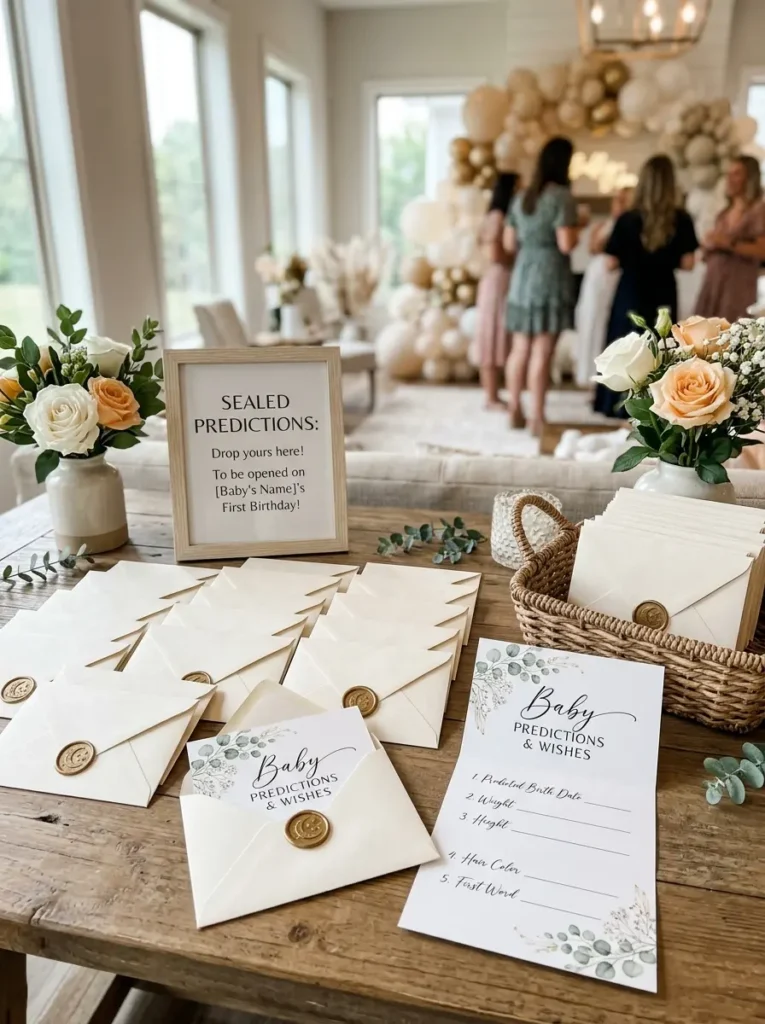
What You Need:
- Small kraft paper envelopes (one per guest)
- Custom prediction cards
- Pens
- A master list of predictions kept by the host for the mailing
How to Play: Each guest fills in their predictions, seals their envelope, and writes their name on the outside. The host collects all envelopes and mails them back to the parents on the baby’s first birthday — the perfect first birthday gift from all the shower guests.
Why It Works: This transforms a standard prediction card into a genuine ongoing connection between the shower guests and the new family — and the first birthday reveal of a room full of predictions is often one of the most emotional and hilarious moments of the entire first year.
Players: All guests
Time: 10 minutes at the shower; priceless on the first birthday
2. Don’t Say Baby (With a Twist)
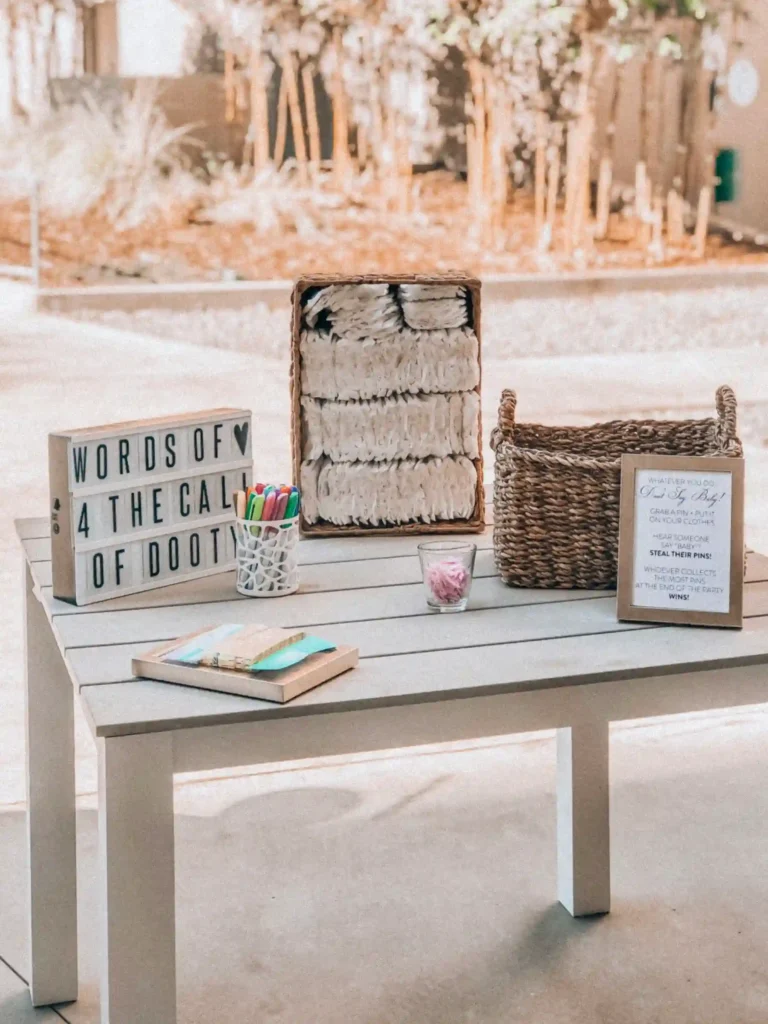
The classic “don’t say baby” game transformed into something genuinely competitive. Instead of a simple pin-stealing setup, guests receive a bracelet of ten beads at the start of the shower. Every time they say “baby,” any other guest who catches them takes one bead. The guest with the most beads at the end of the shower wins a prize.
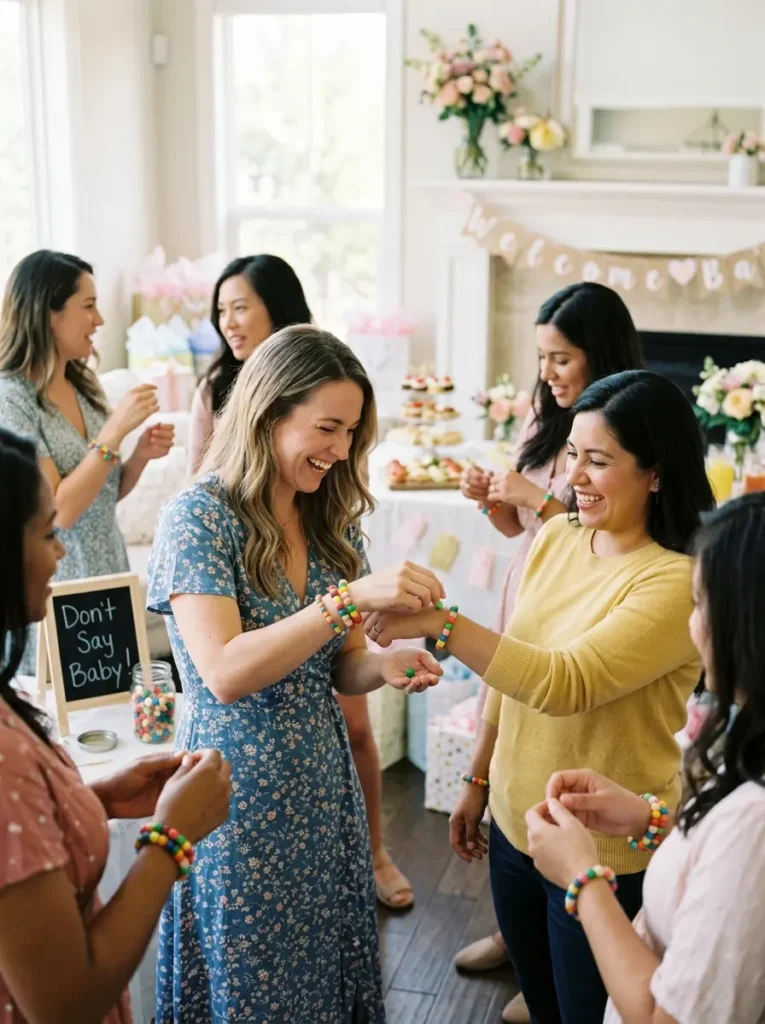
The Twist That Makes It Better: Add three “forbidden words” beyond “baby” — chosen by the mother-to-be in advance and revealed at the start of the shower. The mother-to-be chooses words specifically likely to catch her friends off guard: their own names, the name they have chosen for the baby, or a word commonly used by specific guests.
What You Need:
- Bracelets with ten beads each (or clothespins as a simpler alternative)
- A revealed list of forbidden words on a decorated sign
Why It Works: The three additional forbidden words — chosen specifically by the mother-to-be to catch her specific guests — turn a generic game into something personal, targeted, and genuinely funny. Guests spend the entire shower simultaneously policing themselves and gleefully catching each other.
Players: 6 to 30 guests
Duration: Entire shower
3. Parents’ True Crime: Baby Edition
One of the most popular modern baby shower games — guests are presented with a series of outrageous (but true) parenting fails, ridiculous baby product descriptions, absurd parenting advice from history, or bizarre infant-related news stories, and must guess whether each one is TRUE or COMPLETELY MADE UP.
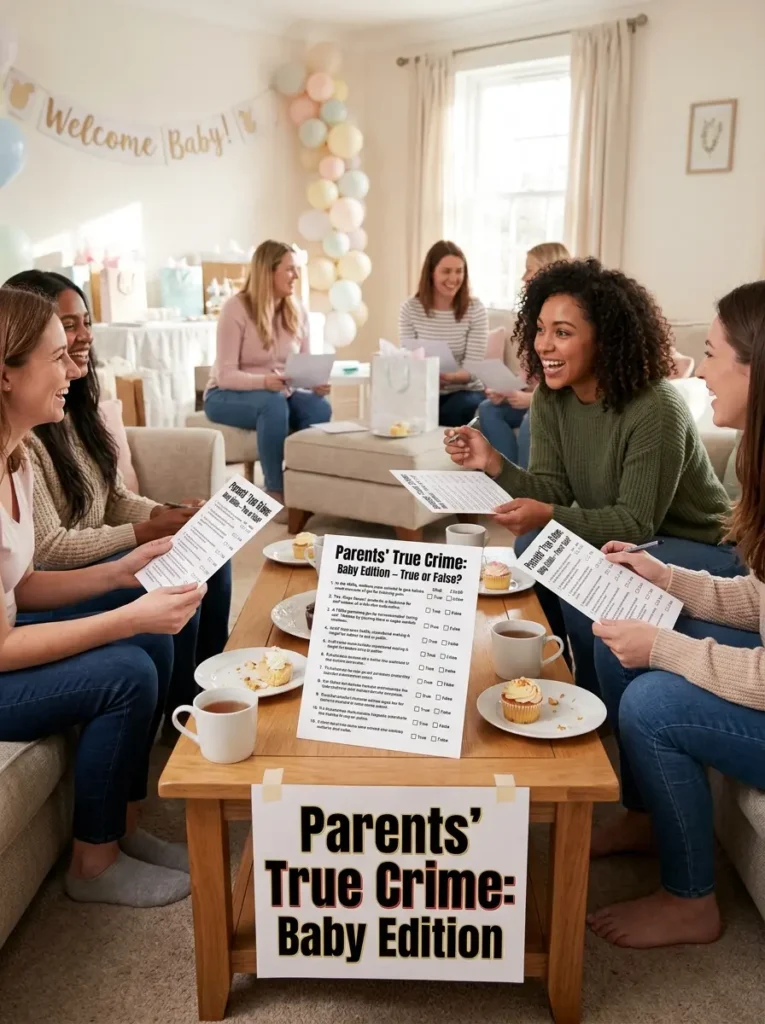
Question Categories:
- Bizarre vintage baby advice (“In 1930, doctors recommended giving babies beer to improve sleep”)
- Real but ridiculous baby product names and descriptions
- Celebrity baby name reveals (some real, some invented)
- Outrageous parenting laws from around the world (many are genuinely real)
- Absurd baby record-book entries from Guinness World Records
How to Play: Host reads each statement aloud. Guests vote True or False by holding up colored cards (green = true, red = false) or writing answers on personal score cards. Each correct answer scores one point. Highest score wins.
What You Need:
- Prepared list of true/false statements (research in advance)
- Colored voting cards or score sheets
- Pens
Why It Works: This game works for every guest — regardless of whether they have children, regardless of age, regardless of relationship to the mother-to-be. It generates genuine debate, genuine laughter, and a remarkable number of “wait, that’s actually REAL?” moments.
Players: 6 to 40 guests
Duration: 15 to 20 minutes
4. Price Is Right: Baby Edition
Guests are shown a series of actual baby product images (displayed on a screen or printed on cards) and must guess the retail price. The guest whose total is closest to the actual combined retail price wins.
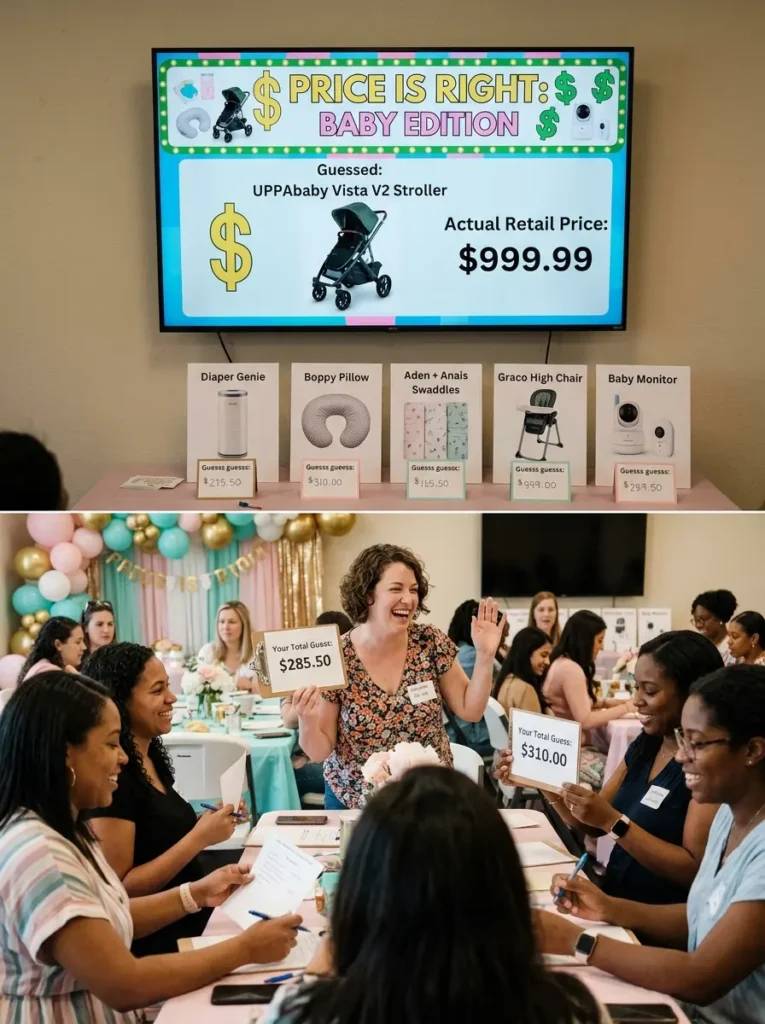
Products to Include:
- A designer baby stroller (prices often astonish non-parent guests)
- A standard box of newborn diapers (price per diaper revealed)
- A baby monitor (range from $30 to $350+)
- A specific baby formula tin
- A breast pump
- A single pair of designer baby shoes
- A video baby camera system
Why It Works: For guests without children, the revelation of what basic baby products actually cost is genuinely shocking and produces the kind of jaw-dropping moment that generates excellent party conversation. For guests with children, it produces knowing nods and “just you wait” glances. For the mother-to-be, it is a genuinely useful exercise in budget awareness presented in a completely fun format.
What You Need:
- Photos of baby products (printed or displayed digitally)
- Actual retail prices (research in advance)
- Score cards and pens
Players: Any number
Duration: 15 minutes
5. Baby Mythology Bingo
Instead of standard baby bingo with generic words, create bingo cards filled with specific predictions, personality traits, and life events — “Will be taller than dad by age 16,” “Will be a terrible singer but love karaoke,” “Will steal the TV remote constantly,” “Will definitely have their mother’s stubbornness.” Guests mark squares as the mother-to-be confirms or disputes each prediction.
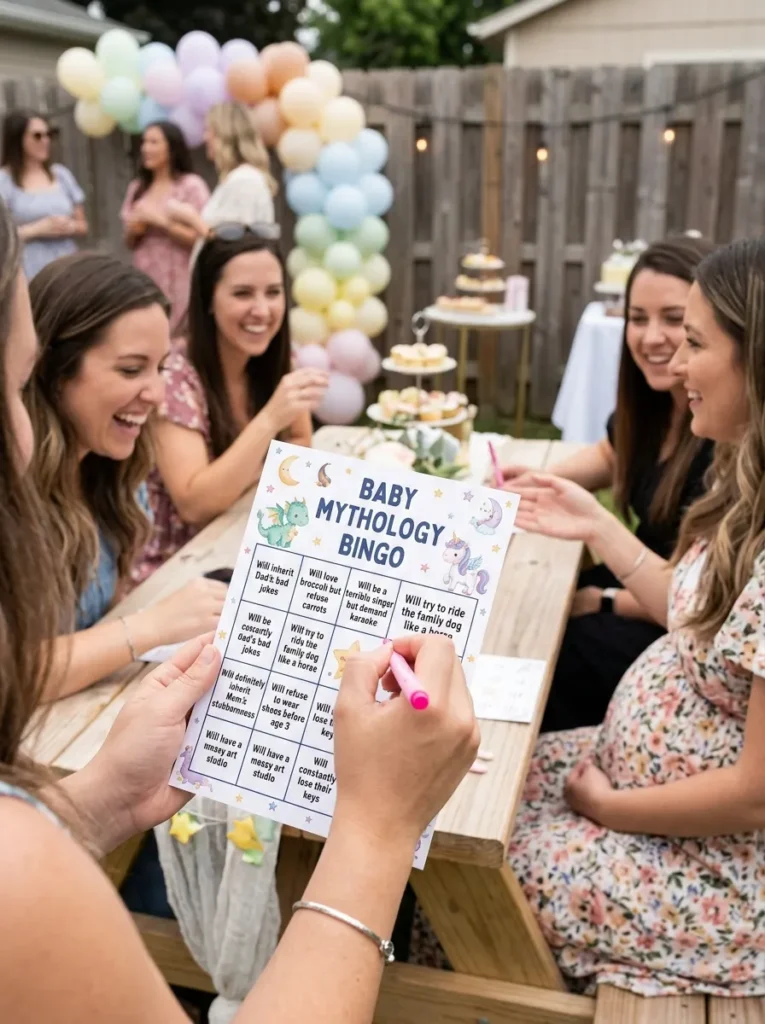
How to Play: Host reads each prediction aloud. The mother-to-be either confirms (“That is definitely going to be true”), disputes (“Absolutely not, not with our genes”), or gives a “we’ll see” — which counts as half a point and adds suspense. Guests mark confirmed predictions on their cards.
What Makes It Non Traditional: The content is completely personalized — every prediction is written specifically about this specific baby, these specific parents, this specific family. No two games of Baby Mythology Bingo are ever the same.
What You Need:
- Custom bingo cards (design on Canva and print)
- Prediction list prepared in advance by the host (collect suggestions from guests beforehand via email or group chat)
- Bingo markers
Players: 8 to 25 guests
Duration: 20 to 25 minutes
PHYSICAL AND ACTIVITY GAMES
6. Diaper Changing Relay Race (Blindfolded)
Teams of two compete to diaper a baby doll as quickly as possible — one person blindfolded, one person giving verbal instructions only, no touching allowed. The combination of blindfold confusion, the impossibility of following verbal diaper instructions, and the desperation as teams fall further behind creates consistent, genuine, deeply joyful chaos.
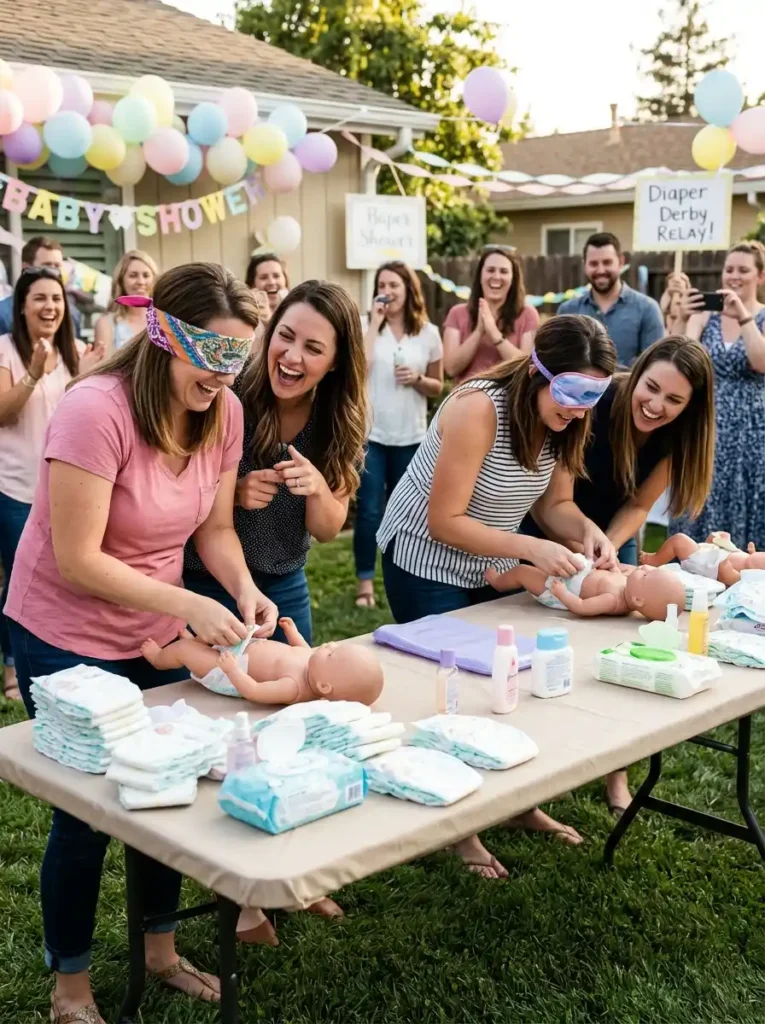
What You Need:
- Two or more baby dolls
- Newborn diapers (the smallest ones make the challenge harder)
- Blindfolds
- Stopwatch
Variations:
- Non-dominant hand only (no blindfold — guests must diaper using only their non-dominant hand)
- Speed round: who can diaper the fastest, unassisted, but must also dress the doll in a baby onesie
- Team relay: each team member completes one step of the diaper change, passing the doll between team members
Why It Works: Everyone underestimates how hard diapering is. The blindfolded version makes this immediately clear in the most hilarious possible way. Guests who are parents dissolve with laughter remembering their early attempts; guests who are not parents experience genuine, productive terror about their future.
Players: 4 to 20 guests (in pairs or teams)
Duration: 15 to 20 minutes
7. Baby Food Taste Test (Savory Edition)
Instead of the standard baby food guessing game, use exclusively savory and unusual flavors — the ones parents actually encounter but that shock non-parents — and have guests taste and rate rather than just identify. Ratings go from “surprisingly okay” to “I will never understand how babies eat this.”
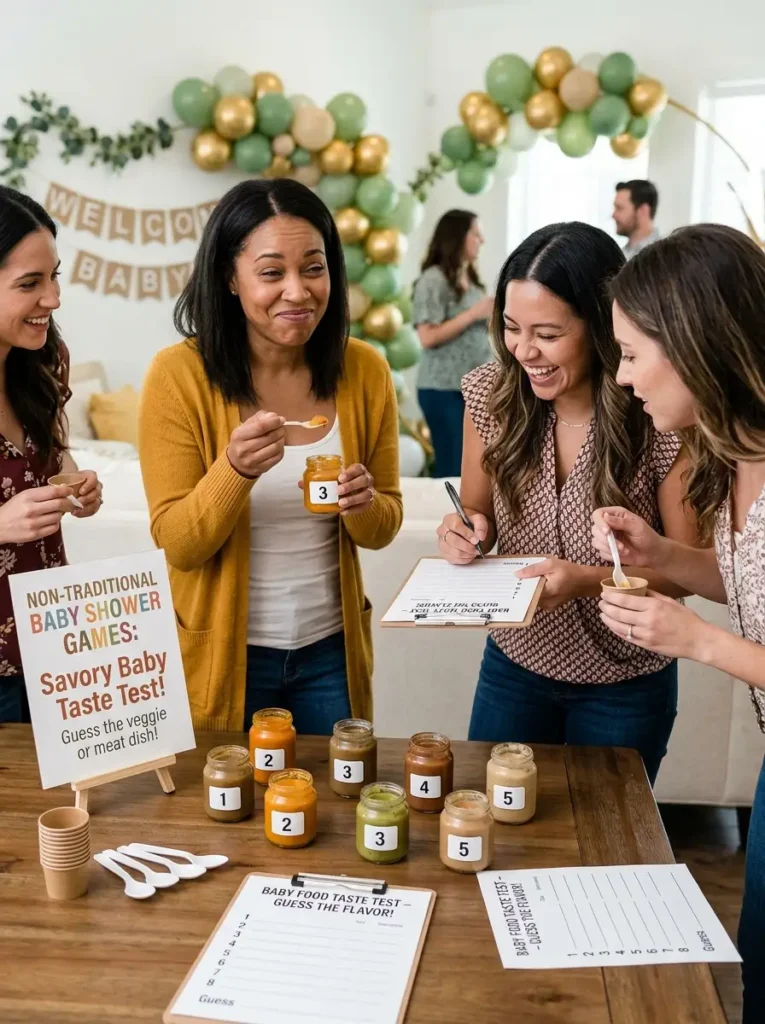
Flavors to Include:
- Sweet potato and turkey (universally acceptable)
- Pea and broccoli puree (challenging)
- Beef and vegetable medley (traumatic for most)
- Prune puree (nobody is ready for this)
- A truly unexpected combination (lamb and mint, for example)
- One completely made-up flavor made by the host from kitchen ingredients
How to Play: Guests taste each numbered sample, rate it on a scale from 1 to 5, and try to identify what it is. The guest who correctly identifies the most flavors wins. The host reveals the invented flavor last — the guest who gave the invented flavor the highest rating wins a special “will eat anything” prize.
What You Need:
- Commercial baby food jars (labels removed, numbered)
- Small spoons (one per guest per sample)
- Rating cards
- Optional: one host-made “fake” baby food
Why It Works: The rating system changes the dynamic from pure identification to genuine assessment — and guests who confidently rate flavors highly are often the ones most surprised by the reveal. The invented flavor creates a delightful additional layer of uncertainty.
Players: 6 to 20 guests
Duration: 15 to 20 minutes
8. Baby Bottle Chugging Race
Guests race to finish the contents of a standard baby bottle — filled with juice, sparkling water, or (at adult showers) a light cocktail — using only the nipple of the bottle. The genuinely difficult physics of feeding from a baby bottle become immediately, hilariously apparent.
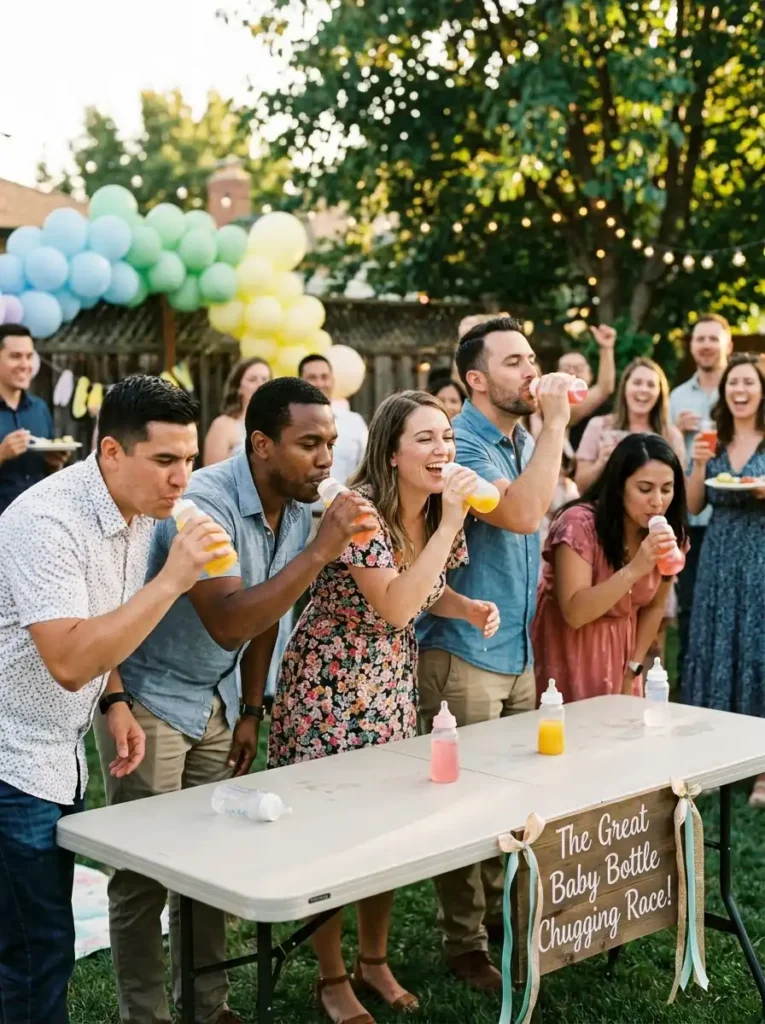
What You Need:
- Standard baby bottles (one per competing guest)
- A beverage to fill them with (juice works universally; a light alcoholic version for adult-only showers where appropriate)
The Revelation: Most adults cannot finish a bottle as quickly as they expect — the bottle nipple flow rate is genuinely restrictive. What seems like a simple race becomes a surprisingly challenging, deeply undignified, and completely hilarious exercise.
Why It Works: Simple to set up, immediate to understand, and universally funny to watch. This game also builds genuine empathy for newborns — feeding from a bottle is genuinely effortful, and guests leave with a new appreciation for what a baby does every two hours.
Players: 4 to 16 guests (competing in rounds)
Duration: 10 to 15 minutes
9. Belly Bump Obstacle Course
Guests strap a balloon (inflated to approximate third-trimester size) under their shirt and attempt a series of everyday tasks — picking up items from the floor, putting on shoes, getting up from a low chair, reaching for something on a high shelf — while wearing the bump.
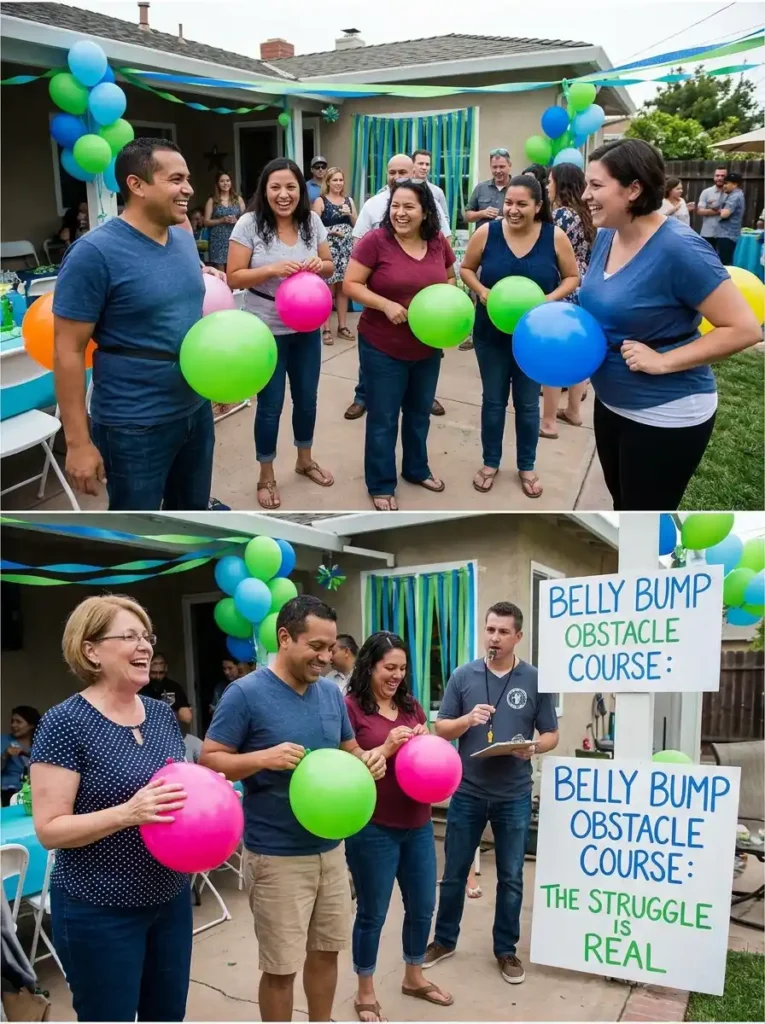
Tasks for the Course:
- Pick up a pen from the floor without bending your knees
- Put on and tie a shoe
- Get up from a low armchair without using your arms
- Carry a laundry basket from one side of the room to the other
- Load a “dishwasher” (a basket on the floor)
- Sit down on the floor and get back up
- Reach for an item placed on a high shelf
Why It Works: Every task that seems trivially simple becomes genuinely, physically challenging with a large balloon bump in the way. Guests who have not been pregnant experience a completely visceral, completely brief, and completely hilarious insight into third-trimester physicality. Guests who have been pregnant deliver an ongoing commentary of “yes, exactly, welcome to my life for three months.”
Players: 4 to 12 guests (competing individually, timed)
Duration: 20 to 30 minutes
10. Midnight Diaper Challenge
Simulate the experience of a 3am diaper change — lights off, a flashlight provided, a crying baby sound effect playing — and guests must complete a full diaper change on a baby doll as quickly as possible in near-darkness while the “baby” is crying.
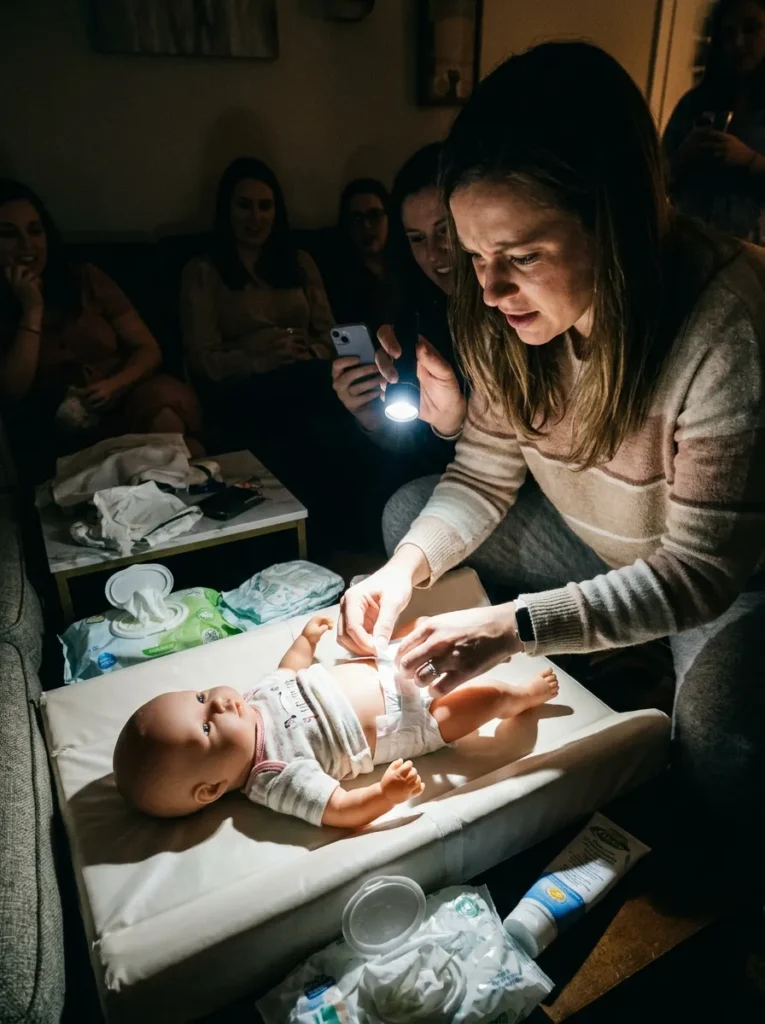
Setup:
- Baby doll, diapers, and wipes on a changing table-height surface
- Room completely darkened (curtains drawn, lights off)
- One small flashlight provided (or phone torch — guests must balance it while changing)
- Crying baby sound effect playing on a speaker (free on YouTube)
- Timer running
Why It Works: This is genuinely revelatory for non-parent guests and deeply nostalgically funny for parent guests. The darkness, the crying, the awkward flashlight juggling — it creates a remarkably accurate simulation of one of the most universally challenging aspects of new parenthood, in a format that is simultaneously empathetic and absolutely hilarious.
Players: 4 to 12 guests (individually timed)
Duration: 15 to 20 minutes
11. Baby Gear Blindfolded Assembly Race
Guests are presented with a disassembled piece of common baby gear — a flat-pack baby bouncer, a pack-and-play travel cot, or a baby carrier — and must assemble it correctly, blindfolded, using only verbal instruction from their team partner.
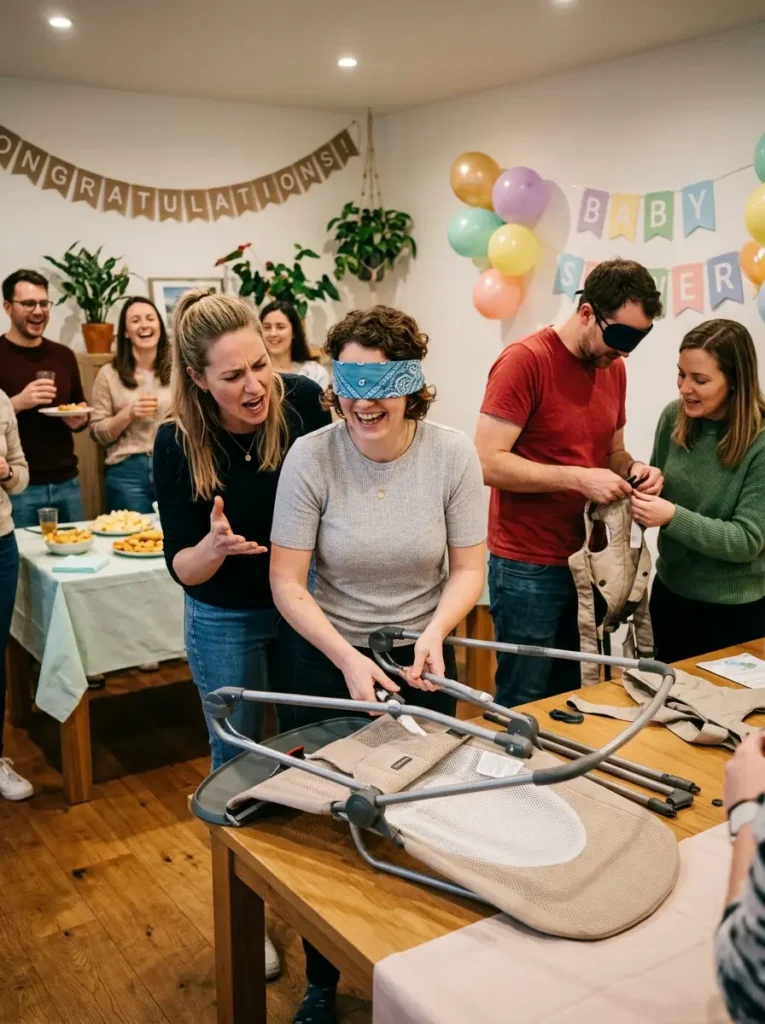
Best Items for This Game:
- Baby carrier (buckles and adjustments are confusing even with instructions)
- Simple baby bouncer chair (snap-together assembly)
- Small travel cot or pack-and-play
- Baby stroller with fold/unfold mechanism
Why It Works: Baby gear is genuinely difficult to assemble even with full vision and instructions. Blindfolded, with verbal-only guidance from a partner who may or may not read instructions, it becomes a comedy of errors that is deeply, specifically funny to any parent who has spent forty-five minutes assembling something at midnight before a hospital discharge.
Players: Teams of 2 to 4 guests
Duration: 20 to 30 minutes
CREATIVE AND ARTISTIC GAMES
12. Onesie Decorating Station
Each guest is given a plain white newborn or 0-3 month onesie and fabric markers, iron-on transfers, or fabric paint — and thirty minutes to decorate it with whatever they choose. The decorated onesies become a personalized baby wardrobe for the first months of the baby’s life.
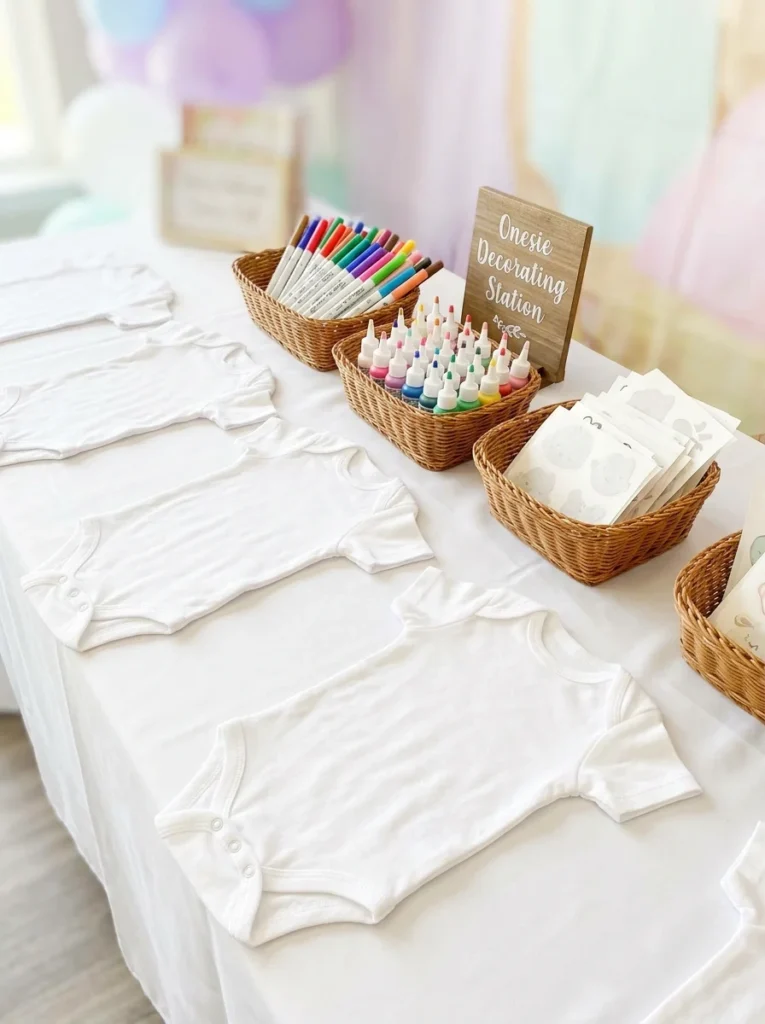
What You Need:
- Plain white onesies in newborn and 0-3 month sizes (one per guest)
- Fabric markers (Tulip brand is excellent quality)
- Optional: fabric paint, foam stamps, stencils, iron-on patches
- Cardboard inserts for inside each onesie to prevent bleed-through
- Protective table coverings
Display and Prize Ideas: Display all completed onesies at the end of the shower for guests to vote on categories — most creative, funniest, most sentimental, most likely to be the baby’s favorite. The mother-to-be chooses her personal favorite for a prize.
Why It Works: This game produces both a genuine party activity and a genuinely useful gift. The baby ends up with a completely unique, personally made wardrobe from the specific people who celebrated their arrival — and the mother-to-be can remember exactly who made each onesie as she dresses her baby in the early months.
Players: All guests simultaneously
Duration: 30 minutes (allow more time for detail-oriented guests)
13. Draw the Baby
Each guest draws their prediction of what the baby will look like — using crayons, markers, or pencils — without lifting their pen from the paper. The no-lift rule means lines must be continuous, creating drawings that range from surprisingly competent to absolutely magnificent in their wrongness.
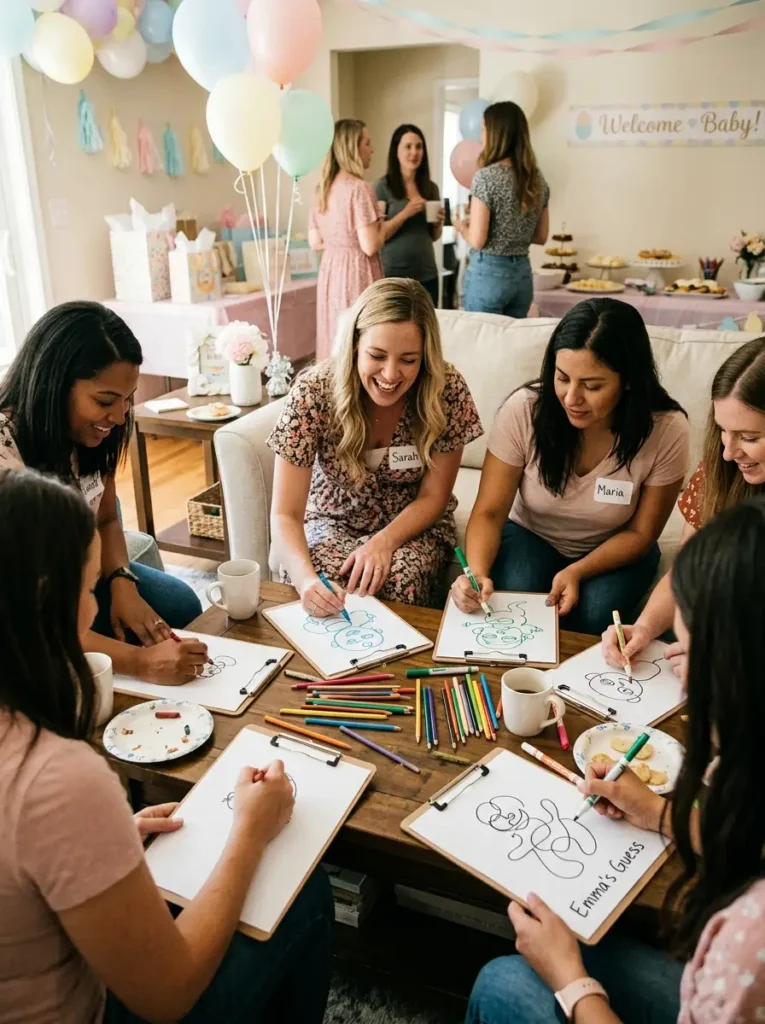
The No-Lift Rule: Guests must draw the baby’s face (or full body) as a continuous line — the pen never leaves the paper. This creates beautiful artistic chaos for most guests and produces drawings that are simultaneously endearing and hilarious.
Reveal Options:
- All drawings are displayed and guests vote on the most accurate prediction (to be verified once the baby arrives)
- The mother-to-be chooses her favorite for a small prize
- Drawings are compiled into a small book kept for the baby
Why It Works: The no-lift rule eliminates any skill advantage and creates leveled, genuinely funny results regardless of artistic ability. The comparison between the drawings and the eventual baby is a source of joy throughout the first year.
Players: All guests
Duration: 10 to 15 minutes
What You Need: Paper, markers or crayons, timer
14. Nursery Rhyme Rap Battle
Teams are given a classic nursery rhyme — Humpty Dumpty, Jack and Jill, Little Bo Peep — and ten minutes to rewrite it as a hip-hop verse about modern parenthood. Teams then perform their rap to the room, with the mother-to-be judging the winner.
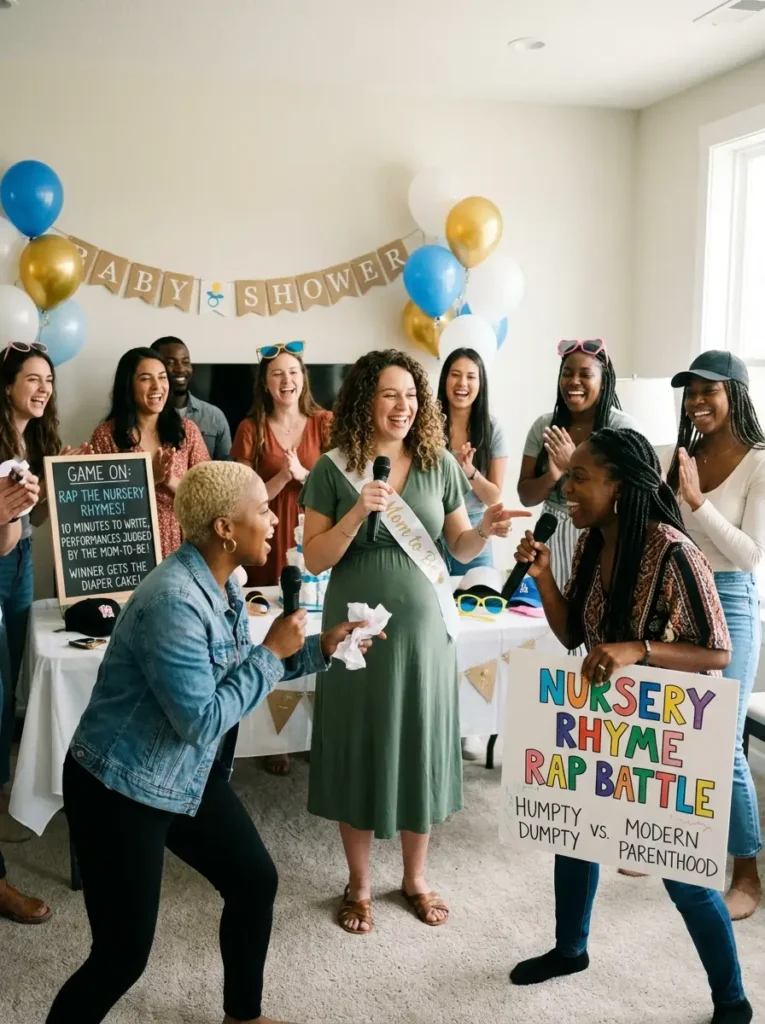
How to Play:
- Divide guests into teams of three to four
- Each team draws a nursery rhyme from a hat
- Teams have ten minutes to rewrite the rhyme as a rap (keeping the original rhyme scheme but updating the content to modern parenting)
- Each team performs their rap
- The mother-to-be and father-to-be (if present) judge on lyrics, delivery, and creativity
Example Starting Point: Original: “Rock-a-bye baby, on the treetop, when the wind blows the cradle will rock” Rap version: Teams rewrite about sleep training, swaddling, or the realities of nighttime feeds
Why It Works: The combination of childhood nostalgia (nursery rhymes) and adult creativity (writing and performing a rap) produces consistently hilarious results regardless of musical ability. The performance element creates genuine audience engagement and the competitive judging by the parents-to-be makes the outcome feel personal and meaningful.
Players: 6 to 24 guests (in teams)
Duration: 25 to 35 minutes including performance time
15. Watercolor Baby Portrait Prediction
Guests paint a small watercolor prediction of what they think the baby will look like — using a simple watercolor kit and a small card. No artistic skill required (or expected). The portraits are collected and kept in an envelope to be compared against reality at the baby’s first birthday party.
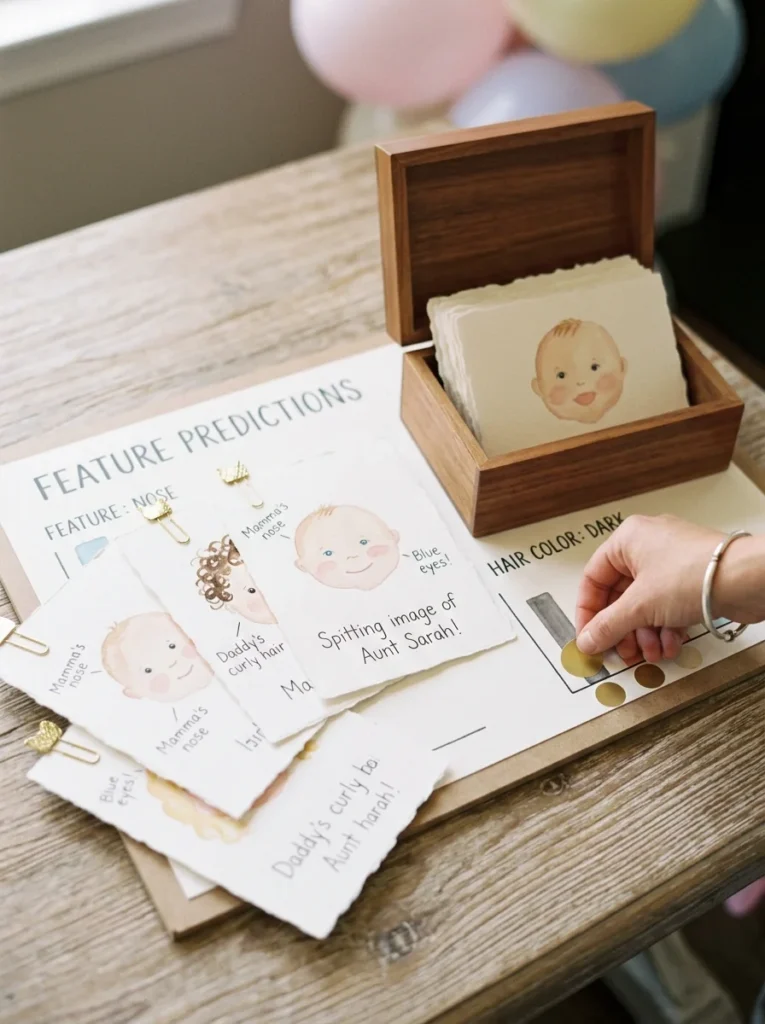
What You Need:
- Small watercolor kits (simple 12-color sets from craft stores)
- Watercolor paper cards (cut to 4×6 inches)
- Small brushes and water cups
- Guest name labels for the back of each card
Why This Version Works Better Than Pencil Drawing: Watercolor is forgiving, colorful, and produces beautiful results even for non-artists. The wet-on-wet technique that most non-artists naturally use creates soft, impressionistic portraits that are charming regardless of accuracy.
Players: All guests
Duration: 20 to 25 minutes
16. Advice Jar with Unexpected Prompts
Rather than standard “advice for the new parents” cards (which tend toward the generic and the predictable), each guest draws a specific, unexpected prompt from a jar and must write advice specifically for that situation.
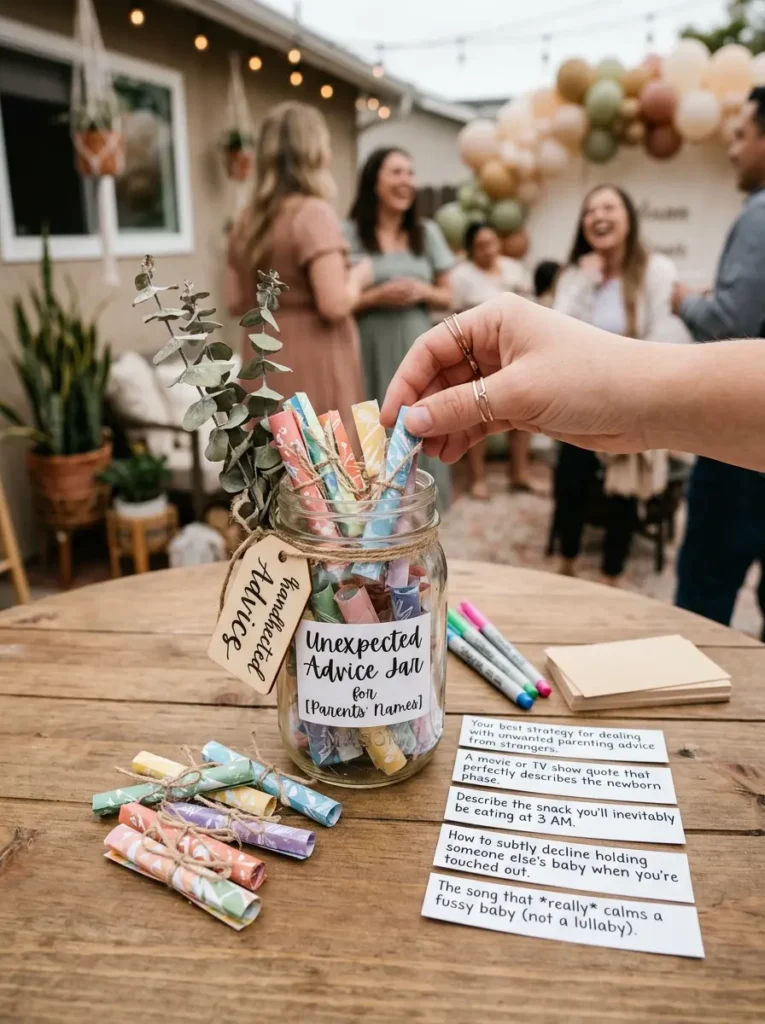
Unexpected Advice Prompts:
- “Advice for the first time the baby projectile vomits in public”
- “Advice for when the baby refuses to sleep for the fifth consecutive night”
- “Advice for the first time a stranger in a supermarket tells you you’re doing it wrong”
- “Advice for when both parents are convinced the other is not doing enough”
- “Advice for the first time the baby clearly prefers the other parent”
- “Advice for the first time you genuinely cannot figure out why the baby is crying”
- “Advice for when you realize your pre-baby self had absolutely no idea”
- “Advice for the exact moment it becomes worth everything”
Why It Works: The unexpected specificity of the prompts produces advice that is genuinely useful, specifically funny, and deeply personal in a way that generic “just love them and enjoy every moment” advice never is. The reveal of all advice cards at the shower (or saved for the parents to open later) consistently produces the most emotionally genuine moments of any shower.
Players: All guests
Duration: 10 minutes
COMPETITIVE GROUP GAMES
17. Baby Name Speed Round
Two teams compete to name babies as fast as possible in rotating categories — “a baby name that’s also a fruit,” “a baby name that’s also a day of the week,” “a baby name that sounds made up but is actually real,” “a baby name that was a number one hit in the 1980s” — with thirty seconds per category. The team that names the most babies in each category scores a point.
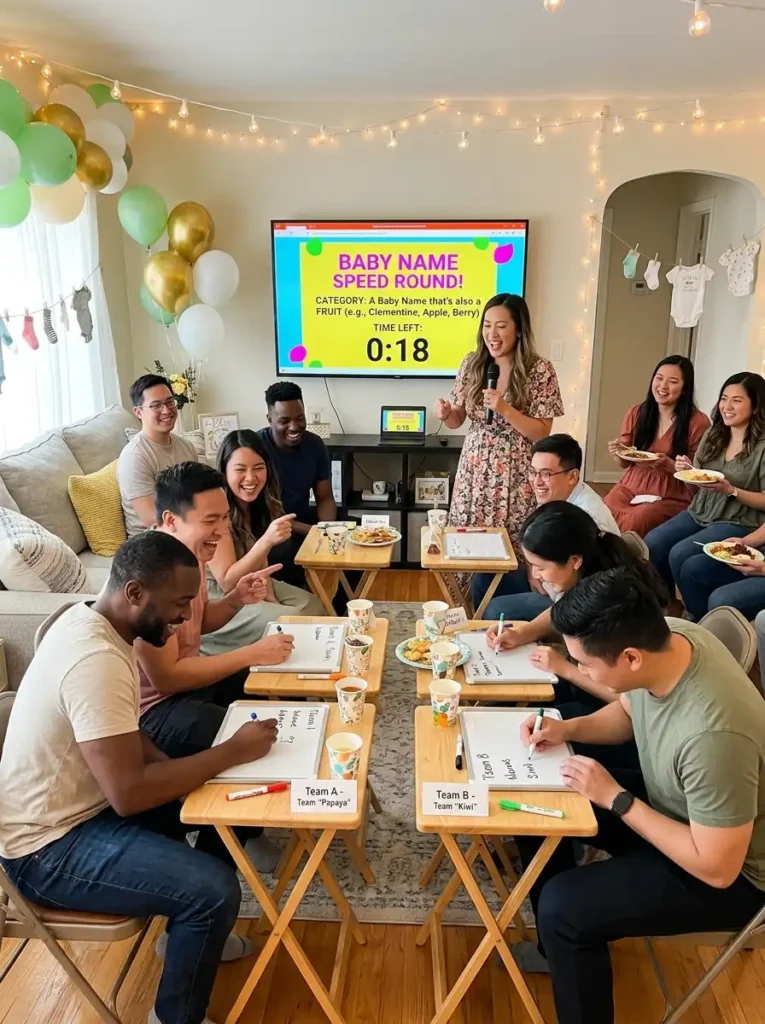
Best Categories:
- Baby names that are also foods
- Baby names that were in the top 10 in 1985 (players name as many as possible in 30 seconds)
- Baby names that have been banned in at least one country (players guess which names)
- Baby names that are secretly old-fashioned coming back as trendy
- Celebrity baby names (real or invented — teams must identify which are real)
Why It Works: Baby names are something every shower guest has opinions about — strong, specific, often hilarious opinions — and a competitive format channels those opinions into genuine entertainment. The categories create variety and keep the game from becoming repetitive.
Players: 8 to 30 guests (in two teams)
Duration: 20 to 25 minutes
18. The Parent Quiz
A comprehensive quiz testing knowledge specifically about the parents-to-be — not generic parenting questions, but specific knowledge about this specific couple. Who proposed first? What was their first holiday together? What does the father-to-be secretly hope the baby’s personality will be like? What has the mother-to-be said she will definitely do differently from her own parents?
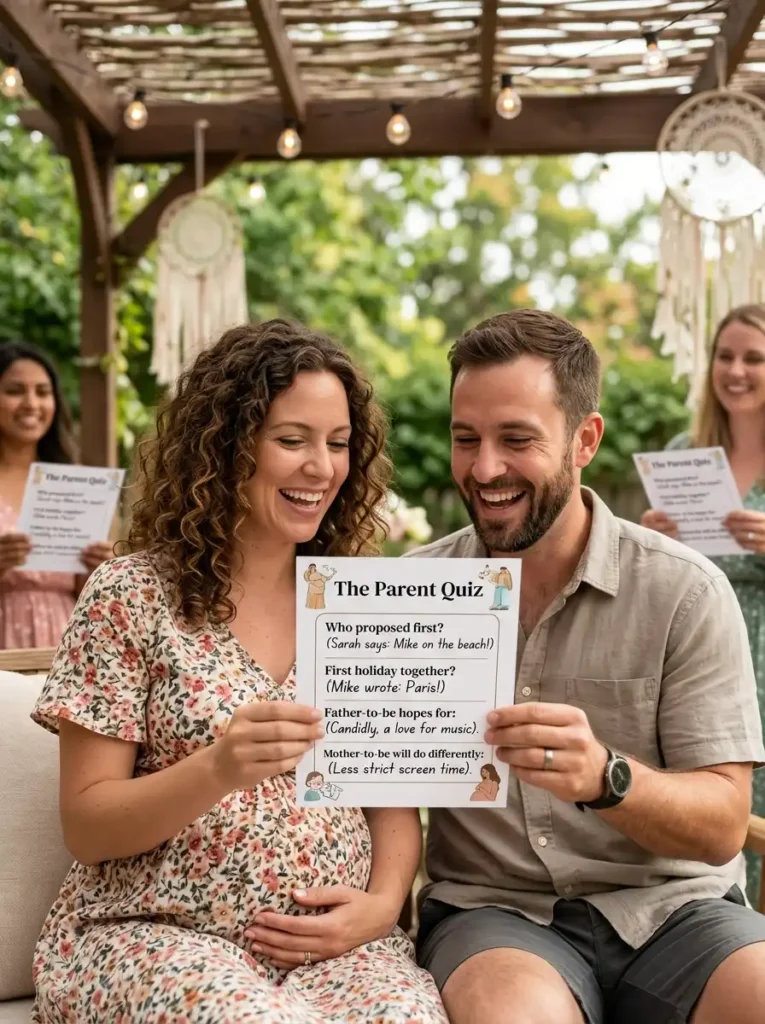
Question Categories:
- Factual questions about the parents’ relationship history
- Predictions questions (guests predict what the parents will say about specific future scenarios)
- “Would You Rather” parenting dilemmas where guests predict which option each parent chooses
- Embarrassing childhood stories about each parent (supplied in advance by their own parents)
Guest vs Parents Competition: The most entertaining format has guests compete against the parents-to-be directly — guests predict what the parents will answer, parents answer live, guests score points for correct predictions. The discrepancy between what guests predict and what the parents actually answer produces consistent, genuine comedy.
Players: All guests vs parents-to-be
Duration: 25 to 30 minutes
19. Baby Animal Name Challenge
Guests race to name the correct term for baby animals — a baby goat is a kid, a baby swan is a cygnet, a baby kangaroo is a joey — in teams. Sounds simple until the genuinely obscure ones arrive.
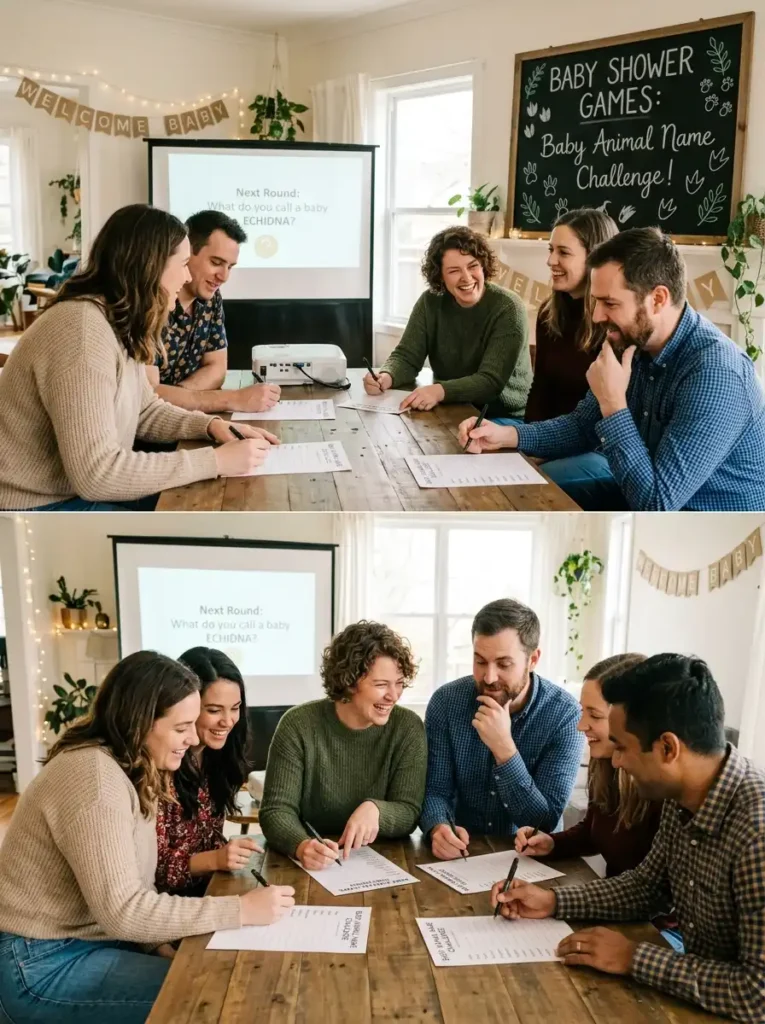
Easy Starters:
- Baby cat (kitten) ✓
- Baby dog (puppy) ✓
- Baby kangaroo (joey) ✓
Medium Difficulty:
- Baby deer (fawn) — most people know this
- Baby goat (kid) — known
- Baby swan (cygnet) — starts to get challenging
Genuinely Difficult:
- Baby hedgehog (hoglet) — almost nobody knows this
- Baby platypus (puggle) — this produces universal shock
- Baby wombat (joey — same as kangaroo!) — the trap question
- Baby oyster (spat) — completely unknown to most
- Baby ferret (kit) — confused with kitten
- Baby porcupine (porcupette) — genuinely one of the best words in English
Why It Works: The game begins as something everyone feels confident about and progressively reveals how little anyone knows — a genuinely funny collapse of confidence that produces exactly the kind of collective “wait, WHAT?” moments that make a game memorable.
Players: 6 to 30 guests (in teams)
Duration: 15 to 20 minutes
20. Guess Who: Baby Photo Edition
Every guest submits a baby photograph of themselves before the shower (requested on the invitation or via a group chat). Photos are displayed numbered on a wall or board, and guests match each photo to the adult they believe it depicts. The guest with the most correct matches wins.
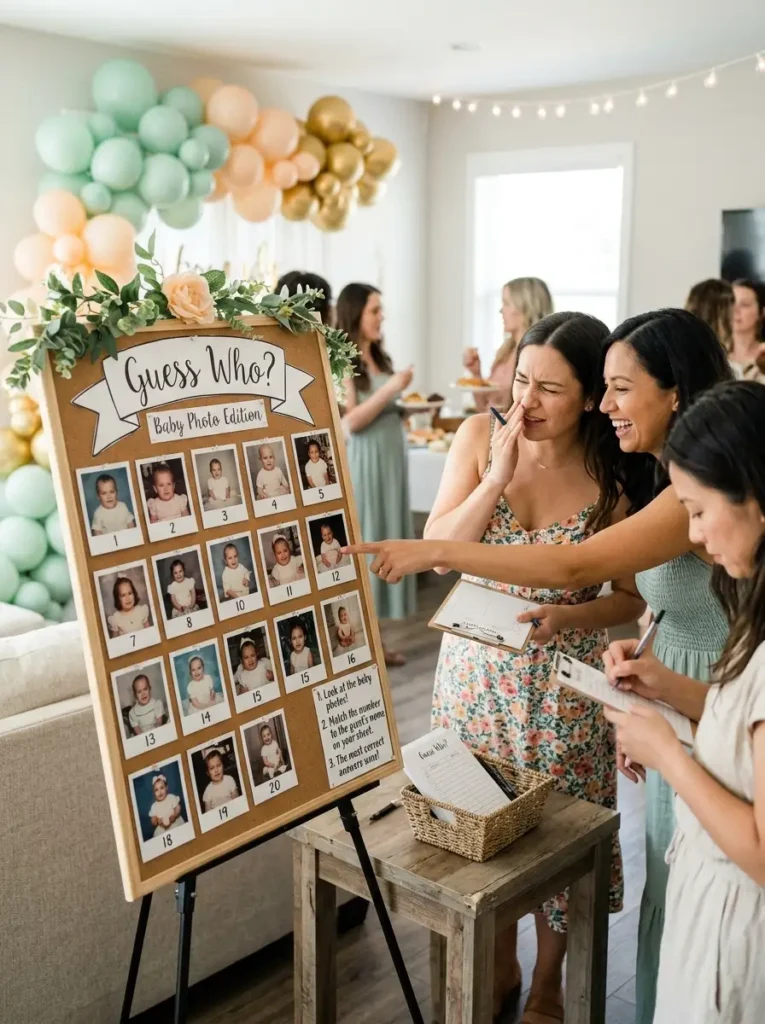
What Makes This Version Non Traditional: Include the parents-to-be’s own baby photos among the display, but also include photos of celebrities, fictional babies, or deliberately misleading baby photos as decoys — guests must identify which photos are genuine guests and which are planted fakes.
What You Need:
- Printed baby photos (requested in advance from guests)
- Number labels
- Answer sheets
- Optional: a few celebrity baby photos as decoys
Why It Works: Baby photos are universally charming — the game creates an immediate wave of “oh, I know exactly who that is!” moments followed by the humbling discovery of how difficult adult identification from baby photographs actually is. The decoy photos add an additional layer of genuine challenge.
Players: All guests
Duration: 15 to 20 minutes
21. Story Stones: Build a Fairy Tale
A collection of illustrated stones (or cards with simple images) is placed in the center of the table — a castle, a dragon, a baby, a shoe, a moon, a magic wand, a talking animal. Each guest draws two to three stones and must contribute two sentences to a continuous group fairy tale that incorporates all the images drawn.
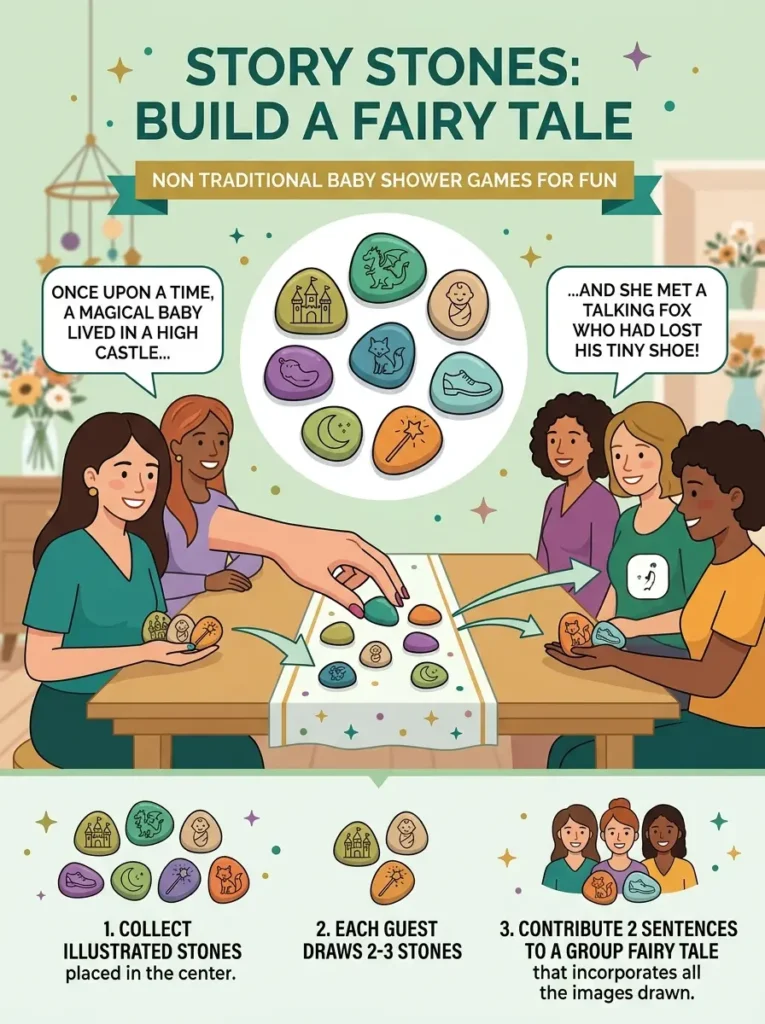
How to Play: The host begins the story with an opening line. Each guest, in order around the table, draws two stones from the bag and must continue the story — incorporating whatever images they drew. The story continues until everyone has contributed, or until it reaches a natural conclusion (or glorious chaos).
Why It Works for Baby Showers: Story stones require creativity, quick thinking, and the ability to connect random images into a narrative — skills that, guests discover, are remarkably similar to the improvisational parenting required when a toddler asks why the sky is blue, why dogs don’t wear shoes, and whether dinosaurs could swim — all before breakfast.
Players: 6 to 16 guests
Duration: 20 to 30 minutes
22. Celebrity Baby Name Match
Guests are given a list of celebrity children’s names and must match each name to the correct celebrity parent. Some names are genuine, some are invented — guests must also identify which names are real celebrity children and which are fabricated.
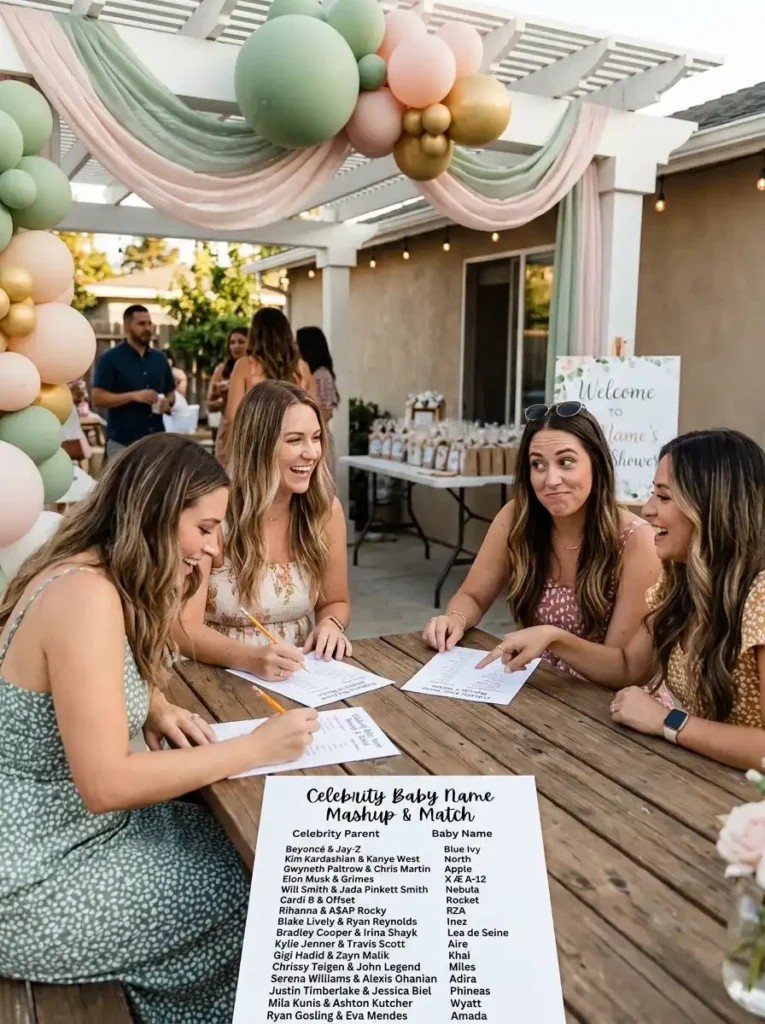
Why This Game Hits Differently: Celebrity baby names have reached a level of genuine creativity that makes the invented names indistinguishable from the real ones. “Pilot Inspektor,” “Apple,” “Zuma Nesta Rock,” and “North West” are all completely real — but they consistently fool guests who are certain they must be invented.
What You Need:
- Printed list of celebrity parent names on one column
- Printed list of children’s names (mixed real and invented) on another column
- Answer sheets
Players: Any number (individually or in teams)
Duration: 15 to 20 minutes
HEARTFELT AND MEANINGFUL GAMES
23. Letter to the Baby Time Capsule
Rather than a game with a winner, this is a meaningful group activity where each guest writes a short letter to the baby — to be opened by the baby on a specific future birthday (eighteenth birthday is popular, though first birthday letters are also beautiful). Letters address the baby directly, sharing the guest’s hopes, predictions, and feelings about the baby’s arrival.
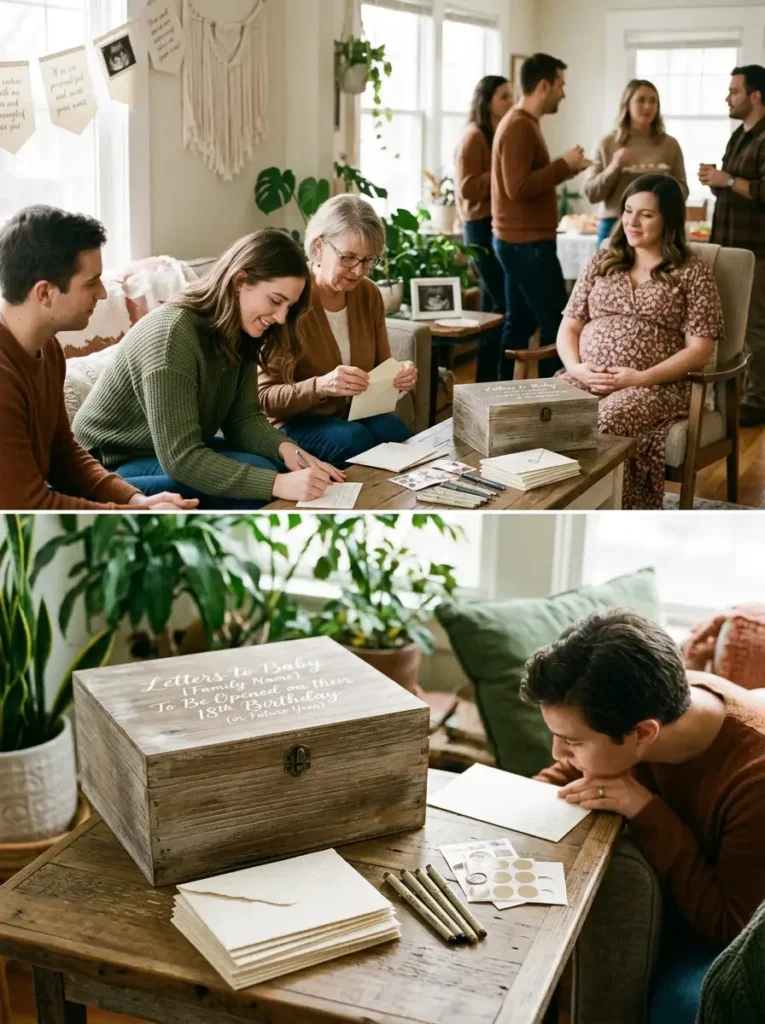
Letter Prompts (displayed on a sign):
- “By the time you read this, the world will…”
- “The thing I most hope for you is…”
- “Your parents on the day you were celebrated before you arrived…”
- “The piece of advice I wish someone had given me at your age is…”
What You Need:
- Quality writing paper (not generic printer paper — this is a permanent keepsake)
- Pens
- Envelopes
- A beautiful keepsake box or tin to hold the letters
Why It Works: Letters to the baby are one of the most consistently moving and most consistently appreciated elements of any baby shower — both in the moment and in the years that follow. The specific prompt “by the time you read this, the world will…” creates letters that become time capsules of the cultural moment of the baby’s birth.
Players: All guests
Duration: 15 to 20 minutes
24. Kindness Cards for the New Parents
In the first weeks and months of a new baby’s life, one of the things new parents need most is practical, specific help — not generic “let me know if you need anything” offers, but actual, scheduled, committed support.
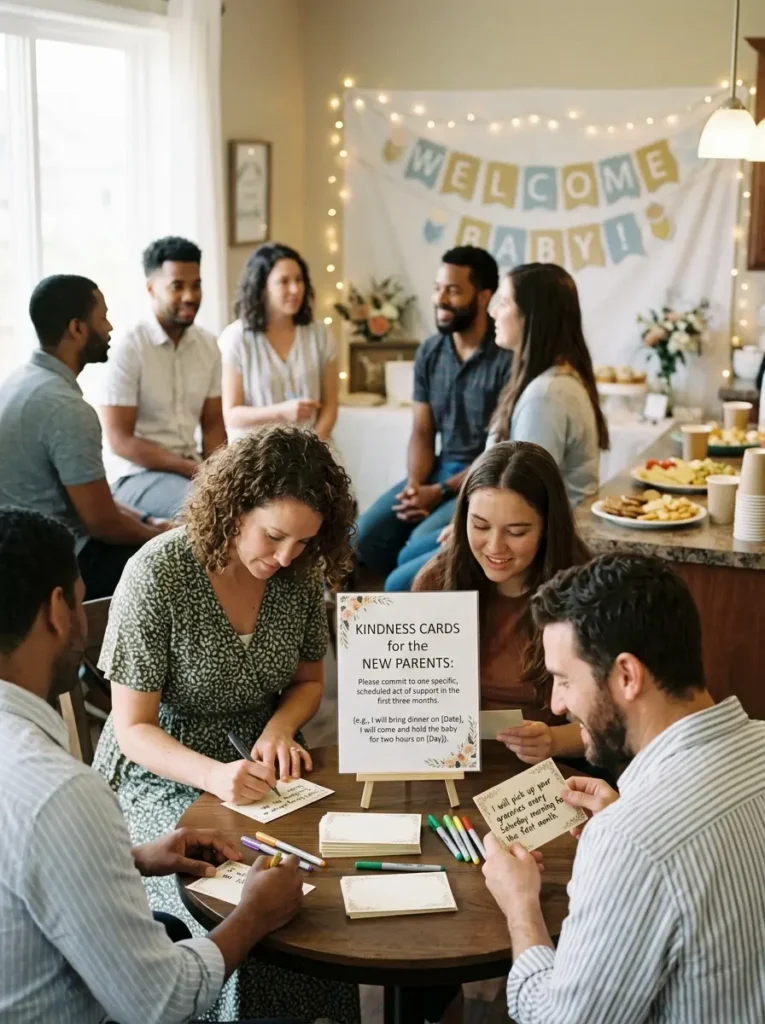
Each guest completes a “kindness card” — a small card that represents one specific, scheduled act of support they commit to providing in the first three months: “I will bring dinner on Tuesday the 15th,” “I will come and hold the baby for two hours on Wednesday afternoon so you can sleep,” “I will pick up your groceries every Saturday morning for the first month.”
Why It Works: This transforms a heartfelt but vague “I’ll help however I can” into specific, genuine, scheduled commitments that actually make a measurable difference to new parents’ lives. The stack of kindness cards represents real, tangible support — and the mother-to-be often describes this as the most meaningful element of her entire shower.
What You Need:
- Beautifully designed commitment cards (design on Canva and print)
- Pens
- A collection jar or box
Players: All guests
Duration: 10 minutes
25. Parenting Wisdom Jenga
A large Jenga set — with parenting advice, funny predictions, and personal messages written on each block — becomes both a shower game and a permanent keepsake that the family plays at every future gathering.
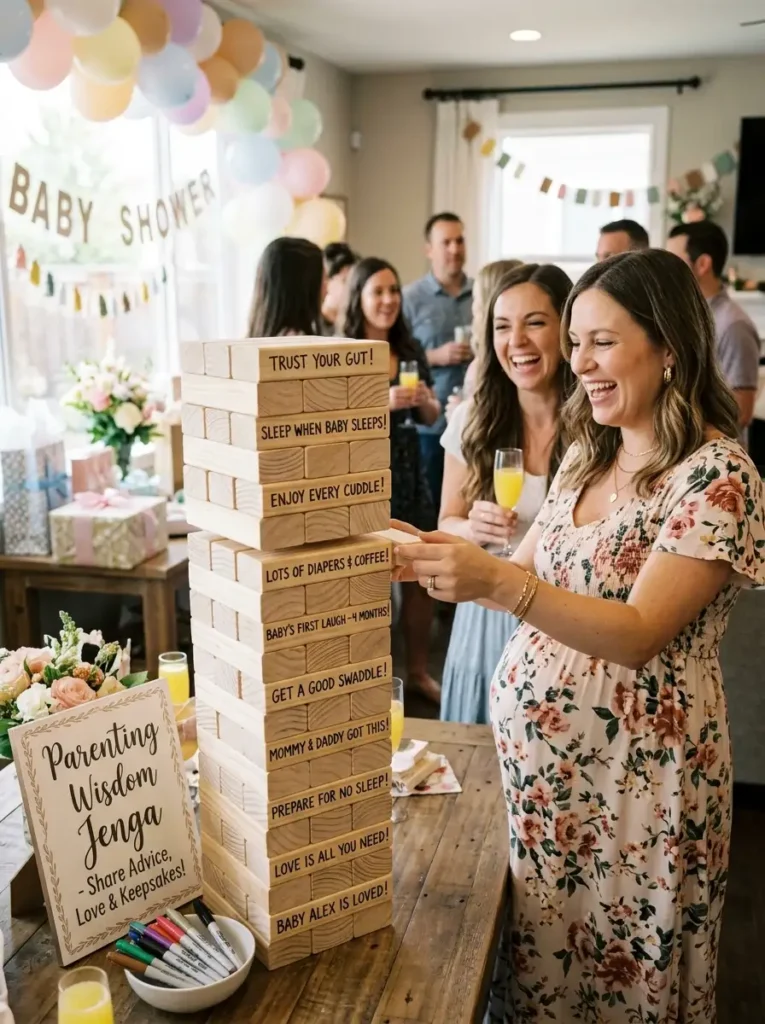
How to Set It Up: Before the shower, set up the Jenga set with marker pens and invite guests as they arrive to write on individual blocks — parenting advice, a personal message to the baby, a prediction about the baby’s personality, a funny memory involving the mother-to-be. Then play Jenga as a group activity during the shower.
Why It Works: The written blocks make every future game of Jenga a trip through the messages of people who celebrated this baby’s arrival — the family plays it when the child is seven, reads the blocks, and it becomes a beautiful time capsule disguised as a family game.
What You Need:
- Standard or Giant Jenga set
- Permanent markers
- A large table for playing
For more creative and beautiful ideas for meaningful keepsakes that guests can contribute to at a celebration, these baby shower themes offer dozens of inspired concepts for personalizing every element of a baby shower.
Players: 4 to 12 guests for the game; all guests for the writing
Duration: Writing: 15 minutes. Game: 20 to 30 minutes
26. The Village Vision Board
A large poster board is displayed in the center of the room. Guests are given magazines, scissors, glue sticks, markers, and stickers, and spend fifteen minutes collaboratively building a “village vision board” — a collective vision of the world they hope to create for this baby, the values they will contribute, and the support they commit to providing as the baby’s community.
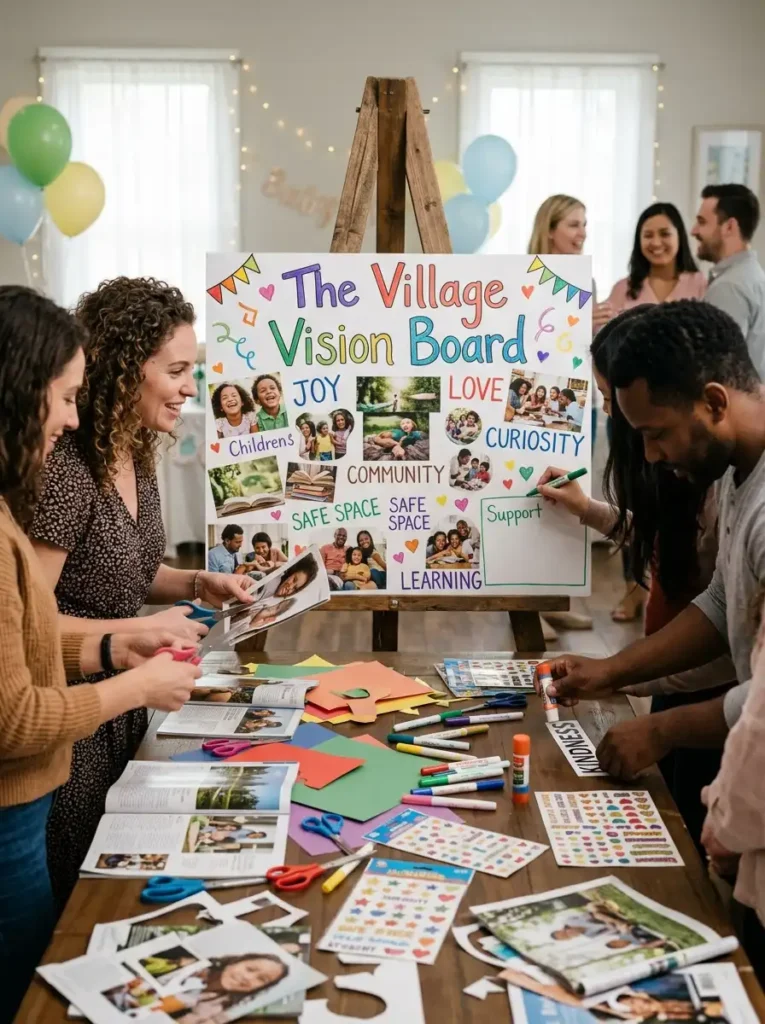
What Goes on the Board:
- Images and words representing values guests want to pass on to the baby
- Individual commitments written directly on the board
- Fun predictions about the baby’s future passions and personality
- Messages of love from everyone present
- Images of the mother-to-be and father-to-be (if present)
Why It Works: The vision board format is collaborative rather than competitive — everyone contributes simultaneously, conversations flow naturally around the table, and the finished board is a beautiful, genuinely meaningful piece of art that can be displayed in the nursery.
Players: All guests simultaneously
Duration: 20 to 25 minutes
27. Name a Star: Constellation Stories
Each guest is given a card showing a simple dot pattern — a constellation layout — and is asked to name the constellation, draw the connecting lines, and write the story of that constellation in two to three sentences. Stories are shared aloud and then compiled into a small book for the baby: a personal mythology created by everyone who loved them before they arrived.
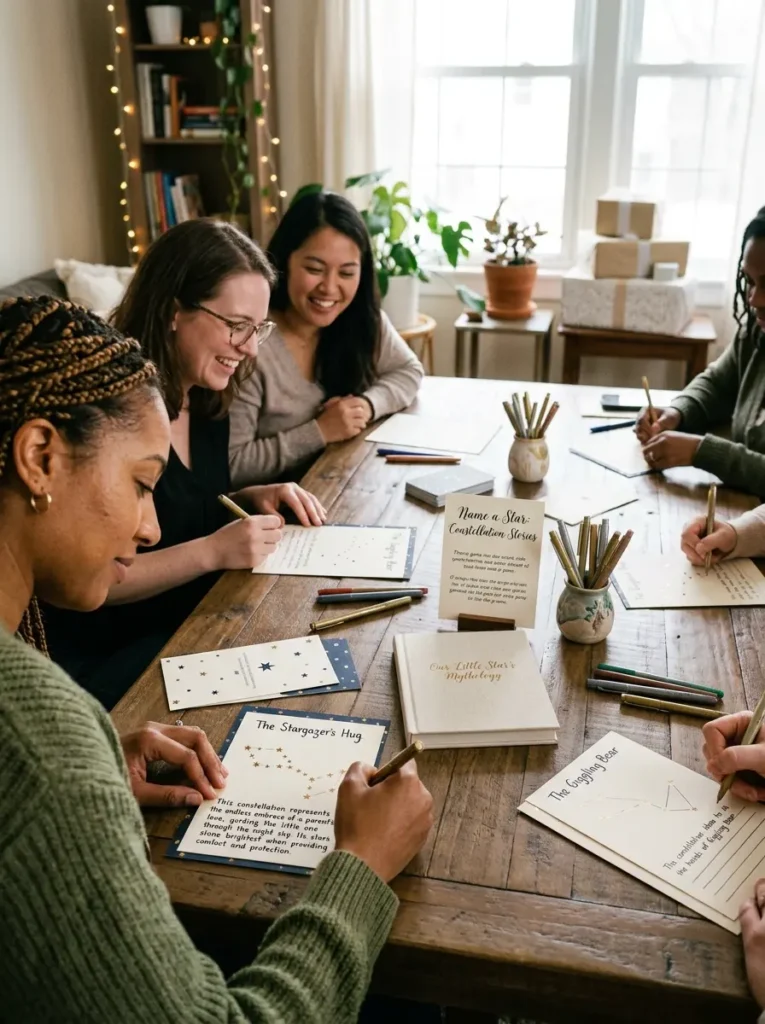
How to Set It Up: Print cards with simple random dot patterns — four to eight dots in various arrangements. Each card is different. Guests name their constellation, connect the dots however they choose, and write a short mythological story about what that constellation represents.
Why It Works: The open-ended creative format means every response is completely unique. Some guests write classical mythology-style stories; some write modern narrative; some write funny parody. The compilation of all the constellations becomes a completely unique, completely personal story collection — the baby’s own mythology, created by their community.
Players: All guests
Duration: 15 to 20 minutes
28. The Baby’s Bookshelf: Sign and Leave
The most elegant and most genuinely useful non game activity available: instead of (or in addition to) signing a traditional guest book, each guest brings a favorite children’s book — inscribed inside with their name, a message to the baby, and a recommendation for the best age to read it together — to add to the baby’s first library.
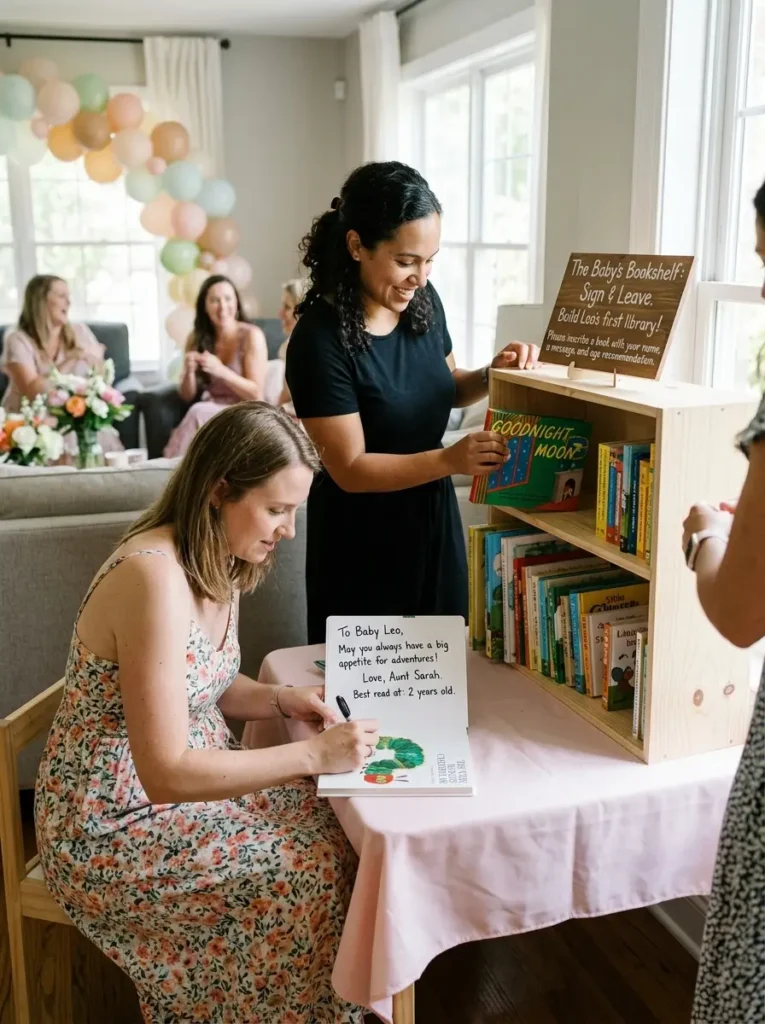
How to Frame It: Include a note on the invitation asking guests to bring their favorite childhood book or their recommended first read for a new baby. Provide a display bookshelf at the shower where books are arranged and browsed, and stickers or bookplates inside each one with space for the guest’s inscription.
Why It Works: The baby ends up with a curated personal library chosen by every person who loved them before they arrived, each book inscribed with a specific message from a specific person who was present at this specific moment. The mother-to-be reads each book to her child over the early years knowing exactly who gave it and why.
What You Need:
- Bookplates or stickers (inside front cover of each book)
- Pens
- A small display bookshelf or crate
For beautiful and creative baby shower themes and ideas that create the perfect atmosphere for these meaningful activities, this guide to trending baby shower ideas covers every styling and theme concept for modern baby showers.
Players: All guests
Duration: Ongoing throughout the shower
GAME SETUP AND PLANNING GUIDE
How to Structure Your Baby Shower Game Schedule
For a Two-Hour Shower:
- One physical or activity game (20 to 30 minutes)
- One knowledge or trivia game (15 to 20 minutes)
- One meaningful activity (10 to 15 minutes ongoing)
For a Three-Hour Shower:
- One physical game (20 to 30 minutes)
- One trivia or knowledge game (15 to 20 minutes)
- One creative activity (20 to 25 minutes)
- One meaningful activity (10 to 15 minutes)
For a Large Group (30+ guests): Choose games that work for large teams or individual simultaneous play — Baby Mythology Bingo, Price Is Right, Baby Photo Match, and Don’t Say Baby work best for large groups. Avoid games that require individual performance in front of a large audience unless your group is particularly extroverted.
For a Mixed Gender or Co-Ed Shower: Choose universally accessible games — Baby Animal Name Challenge, Celebrity Baby Name Match, Price Is Right, and the Diaper Changing Relay Race all work brilliantly for mixed groups. Avoid games that assume a specifically female guest experience.
For an Intimate Shower (Under 12 Guests): Smaller groups suit story-based games, the Letter to the Baby Time Capsule, the Village Vision Board, and the Parent Quiz — formats that create intimate, genuine connection rather than competitive team dynamics.
Prize Ideas for Baby Shower Games
The best baby shower game prizes are small, beautiful, and universally useful:
- Artisan candles
- Quality hand cream or bath products
- A beautiful notebook
- A small plant or succulent
- A gift card to a local coffee shop
- A beautiful bookmark (for the bookshelf game)
- A box of quality chocolates or macarons
- A personalized keychain or small keepsake
- A beautifully packaged tea or coffee selection
Prize Presentation Tip: Display all prizes attractively on a small styled table rather than keeping them hidden until the winner is announced. Guests enjoy seeing what they are competing for, and a beautiful prize display adds to the visual styling of the shower.
BABY SHOWER GAMES PLANNING CHECKLIST
4 to 6 Weeks Before:
- [ ] Games selected (2 to 3 maximum)
- [ ] Any materials that need ordering or printing identified
- [ ] Baby photo requests sent to guests (if using photo game)
- [ ] Custom bingo cards or quiz questions designed and printed
- [ ] Prizes sourced and wrapped
1 to 2 Weeks Before:
- [ ] All game materials prepared and packed
- [ ] Any pre-shower guest requests completed (photos, predictions, book submissions)
- [ ] Game instructions written out clearly (for hosting reference)
- [ ] Timer or phone stopwatch confirmed for timed games
- [ ] Score cards printed (if needed)
Day Before:
- [ ] All materials packed in labeled bags or boxes
- [ ] Prizes confirmed and accessible
- [ ] Any digital elements (Price Is Right display, music for games) tested on device
Day Of:
- [ ] Game station set up before guests arrive
- [ ] Materials accessible and organized
- [ ] Instructions reviewed by host
- [ ] Designate a game host or MC if the shower host needs to manage other elements simultaneously
BABY SHOWER GAMES FAQs
How many games should a baby shower have?
Two to three games is the ideal number for most showers. One game feels slightly token; two to three games creates genuine structure and entertainment without making the shower feel like a game show. More than four games risks exhausting the entertainment value and cutting into the genuinely important time for conversation, gifts, and connection.
How do you make baby shower games more fun for guests who hate games?
The guests who “hate games” almost universally mean they hate the boring, passive, low-stakes games that dominate traditional baby shower formats. Non traditional games — particularly physical activities, competitive trivia, and creative challenges with genuine rewards — consistently convert “I hate games” guests into enthusiastic participants. The key is choosing games with genuine stakes, genuine laughter potential, and genuine relevance to the specific group of people in the room.
What baby shower games work best for co-ed showers?
The best co-ed baby shower games are universally accessible, gender-neutral, and moderately competitive. Baby Animal Name Challenge, Price Is Right Baby Edition, the Diaper Changing Relay Race, Guess Who Baby Photo Edition, and Celebrity Baby Name Match all work brilliantly for mixed groups. Avoid games that assume exclusively female experiences or that ask guests to share personal experiences they may not have had.
How do you host baby shower games for a large group?
For groups over 30, choose games that work with teams rather than individuals — trivia competitions, relay races, and simultaneous activities like onesie decorating. Ensure any verbal explanation or game announcement can be heard by everyone (use a microphone if necessary). For very large groups, consider running two simultaneous smaller game stations rather than one large group activity.
Should the mother-to-be participate in all the games?
Some games suit the mother-to-be’s participation; others suit her role as judge or audience. Games where she is the subject — the Parent Quiz, Baby Mythology Bingo, the Advice Cards — naturally position her as the recipient rather than a competitor. Physical games like the Diaper Challenge or Bottle Race can include her if she wants to participate but should never require her involvement if she is uncomfortable. Always ask in advance which games she wants to participate in versus observe.
What is the most popular non traditional baby shower game?
Based on consistent post-shower feedback, the Letter to the Baby Time Capsule, the Kindness Cards for New Parents, and the Parenting Wisdom Jenga are most consistently described as the games guests remember most fondly — not because they are competitive, but because they produce something genuinely meaningful and lasting. For pure entertainment value, the Midnight Diaper Challenge and the Belly Bump Obstacle Course consistently produce the most laughter.
FINAL THOUGHTS
A great baby shower is not about the games. It is about what the games create — the laughter, the connection, the genuine celebration of a new life about to arrive and a new parent about to be transformed. The games are the vehicle; the joy is the destination.
Choose games that suit your specific group of people, your specific mother-to-be, and your specific vision for the kind of celebration you want to create. Prioritize laughter over perfection, genuine connection over competitive scores, and personal meaning over generic tradition.
The best baby shower game is the one that makes the mother-to-be feel genuinely celebrated — not tested, not embarrassed, not the subject of a game she never wanted to play — but surrounded by people who love her, laughing together, creating memories that belong specifically and permanently to this extraordinary moment.
That is worth planning for. Every single time.
Loved these non traditional baby shower game ideas? Save this article to your planning board and share it with your host — because the best showers are always the ones that are genuinely, thoughtfully, personally planned.
You Might Also Love: