
Planning a baby shower with both men and women? These brilliant co-ed baby shower games are universally fun, genuinely competitive, and designed so every single guest — regardless of gender — has the time of their life.
The co-ed baby shower is one of the best things that has happened to baby shower culture in a generation. When you invite everyone — partners, husbands, male friends, brothers, colleagues — the energy shifts completely. The conversation gets broader. The laughter gets louder. The games get better. And the celebration feels like what it actually is: a party for two parents and the entire community that loves them, not a gender-segregated ritual from a different era.
But here is the challenge that hosts of co-ed showers face: most traditional baby shower games were designed specifically and exclusively for female guests. Games that reference specifically female experiences, games that assume a shared cultural shorthand around motherhood and femininity, games that leave male guests staring politely at their drinks while the women play.
That is not a co-ed shower. That is a regular shower with confused men standing at the edges.
A genuinely excellent co-ed baby shower needs games that work for everyone — games where a rugby player and a grandmother and a work colleague can compete on equal footing, where nobody feels excluded by the premise, and where the most competitive person in the room is just as likely to be the father-to-be’s university friend as the mother-to-be’s sister.
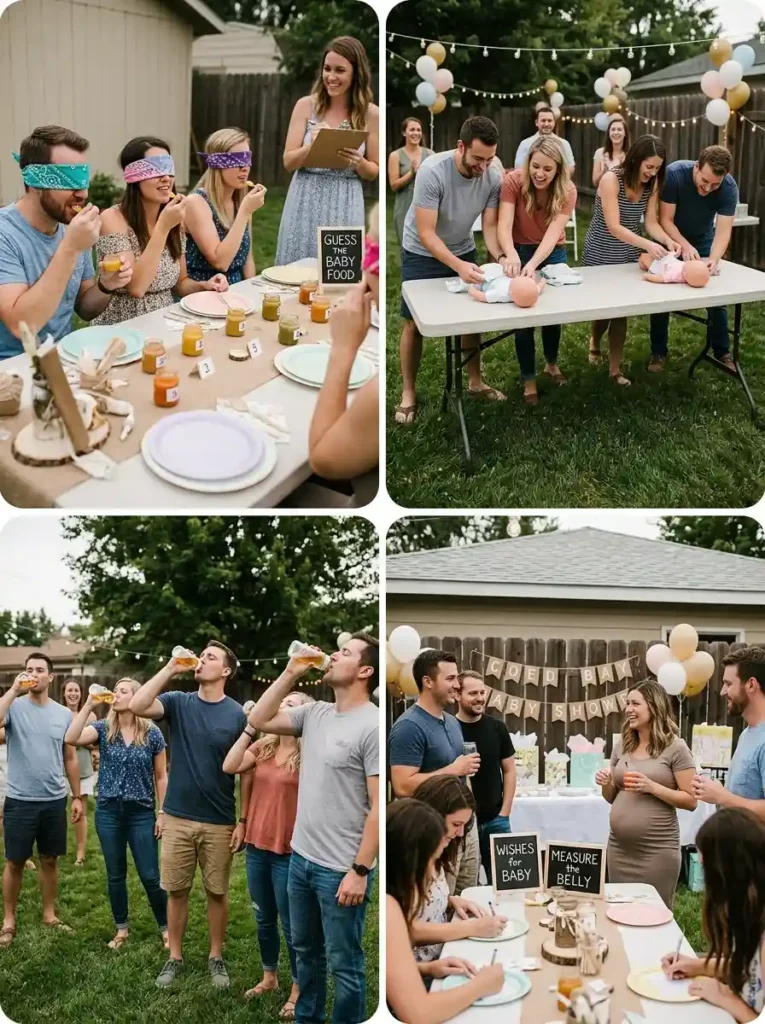
This guide gives you 22 of the best coed baby shower games — games tested and proven to work brilliantly for mixed groups of all ages, backgrounds, and relationships to the parents-to-be. Games that produce genuine competition. Games that generate real laughter. Games that make every single person in the room feel like they belong at this party.
The Golden Rules of Co-ed Baby Shower Games
Before the games, here are the principles that make a co-ed game genuinely work for everyone:
Rule 1: Equal starting point. The best co-ed games give everyone the same knowledge disadvantage. If the game requires specialized parenting knowledge that non-parents don’t have, level the playing field by making the questions equally obscure for everyone.
Rule 2: Physical games are universally funny. Blindfolds, time pressure, awkward tasks — these create comedy that has nothing to do with gender or parenting experience. A blindfolded diaper change is equally humbling for a father of three and a childless 25-year-old.
Rule 3: Competitive formats bring out everyone. Men who politely decline to engage in passive activities will enthusiastically compete in a bracket tournament. Structure matters.
Rule 4: Teams mix the room. Deliberately mix genders and ages in every team game. The best co-ed team game moments happen between people who would not normally interact — and they become the stories guests tell afterward.
Rule 5: The father-to-be is a full participant. A co-ed shower should celebrate both parents. Include the father-to-be in games, not just as a judge or prize-giver. He should be sweating through the diaper relay race just like everyone else.
22 Co-ed Baby Shower Games
PHYSICAL AND COMPETITIVE GAMES
1. The Diaper Changing Olympics
A full multi-event competition testing every skill a new parent will need — all performed on a baby doll, all timed, all equally humbling regardless of parenting experience.

The Events:
Event 1 — Speed Diaper: Change a diaper on the baby doll as quickly as possible. All four tabs must be correctly secured. Crooked tabs add a five-second penalty.
Event 2 — One-Handed Diaper: The same challenge but using only the non-dominant hand. The dominant hand must remain behind the back throughout.
Event 3 — Swaddle Sprint: Swaddle the baby doll in a receiving blanket using a specific technique demonstrated once before the event begins. The swaddle must pass a “will it stay on” test — the judge picks up the swaddled doll by the blanket and it must remain intact for three seconds.
Event 4 — Outfit Race: Dress the baby doll in a full outfit — diaper, onesie with snap buttons, socks, and hat — as quickly as possible. Every item must be correctly positioned and all snaps closed.
Event 5 — Midnight Feed: Blindfolded, locate the baby bottle on the table, pick up the baby doll, and successfully get the bottle nipple into the doll’s mouth. Lights are off. One small flashlight is provided and must be held in the non-bottle hand.
Scoring: Each event is timed. Penalty seconds are added for errors. Lowest combined time across all five events wins. Announce results as though at a genuine athletic competition — the more serious the announcement, the funnier it lands.
What You Need:
- Two baby dolls
- Full supply of newborn diapers
- Baby onesies with snap buttons, socks, hats
- Two receiving blankets
- Two baby bottles
- Two small flashlights
- Blindfolds
- Stopwatch
Best For: Any co-ed shower where the guest list includes at least a few genuinely competitive people
Players: Individual, timed heats (5 to 16 guests)
Duration: 35 to 45 minutes
Why It Works for Co-ed Groups: Diapering skill is equally rare among men and women who don’t have children. Experienced parents discover that time pressure and an audience destroy their technique. The blindfolded midnight feed is equally impossible for everyone.
2. Baby Gear Assembly Race
Teams compete to correctly assemble a piece of baby equipment — a flat-pack bouncer, a baby carrier, a travel cot, or a stroller — as quickly as possible. Instructions are provided but must be divided among team members (each person gets only one page).

The Rules:
- Instructions are divided equally among team members before the game begins
- No team member can see another member’s instruction page
- Verbal communication is allowed; showing your page is not
- The assembled item must be functional and safe — judges test it with the baby doll
Why Baby Gear Assembly Is Perfect for Co-ed Games: Baby gear assembly instruction manuals are designed in a way that makes them equally confusing for everyone. The combination of impenetrable diagrams, multilingual instructions, and pieces that look identical until they are not creates a universally leveling experience.
The Twist That Makes It a Co-ed Gold Medal Game: Divide teams so that each team has an equal mix of people who have assembled baby gear before and people who have not. Then watch the confident experienced parent discover that this specific brand’s instruction system defies all their previous knowledge.
What You Need:
- One (or two) pieces of baby gear to assemble (identical sets for competing teams)
- Instructions divided and distributed
- Baby doll for testing
- Stopwatch
Players: Teams of 3 to 5 guests
Duration: 25 to 35 minutes
Pro Tip: The baby carrier is the best item for this game — the combination of buckles, straps, and adjustments creates maximum beautiful confusion.
3. Pregnant Obstacle Course (Men vs Women)
A relay race where all competing guests wear the pregnancy bump (large balloon under shirt) and must complete a series of timed physical tasks. Run as a men vs women team competition for maximum competitive energy.
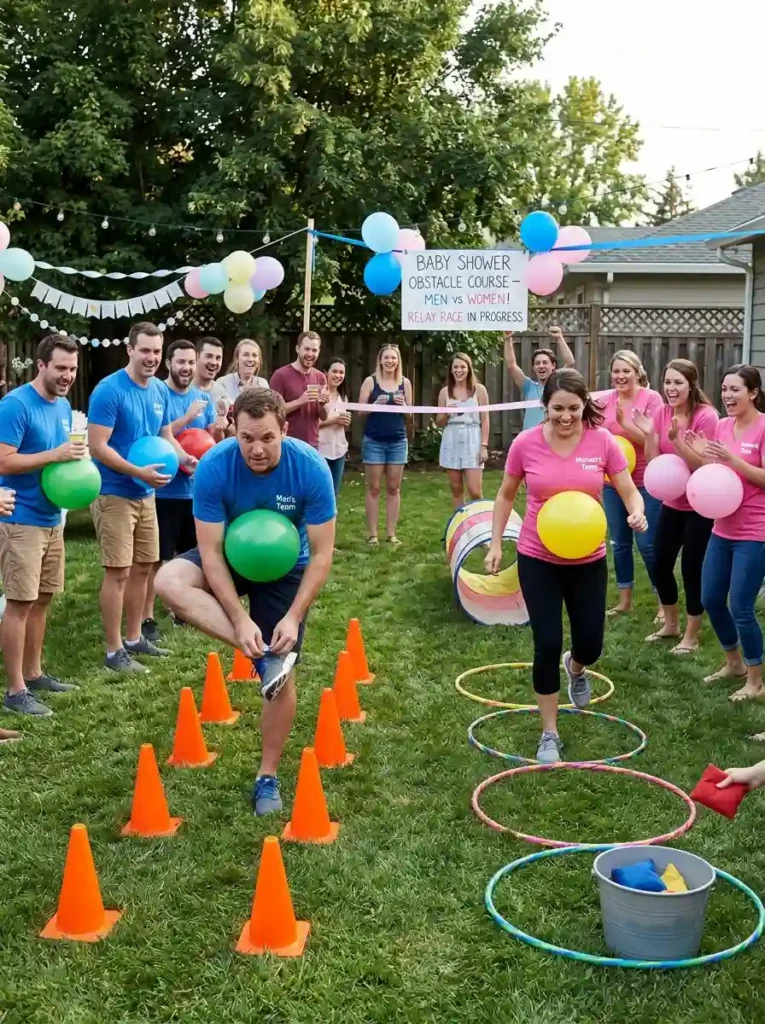
The Obstacle Course:
Station 1: Tie a shoelace (standard shoe, provided)
Station 2: Pick up five objects from the floor without bending knees
Station 3: Sit in a low beanbag chair and stand back up without using hands
Station 4: Carry a full grocery bag from one end of the room to the other
Station 5: Put on and zip up a jacket
Station 6: Load five items into a low dishwasher (basket on the floor)
Team Format: One team member runs the full course at a time, with the next team member beginning as soon as the previous one completes all six stations. Each team member wears the bump for their run. Lowest combined time wins.
The Men vs Women Framing: This specific framing creates immediate competitive energy that benefits the entire game. Men who are confident they will be faster discover, station by station, exactly why the third trimester is called the third trimester. Women who have been pregnant find the game both funny and cathartic. Women who have not been pregnant find it illuminating. Men universally find it humbling.
What You Need:
- Two large balloons per team (spares essential — bumps pop under competitive conditions)
- Oversized shirts for bump accommodation
- One lace-up shoe
- Five small objects for floor pickup
- One low beanbag or armchair
- Grocery bags with light contents
- One jacket with a zip
- One low basket with five items
Players: Two teams of 4 to 8 guests each
Duration: 30 to 40 minutes
4. Bottle Chugging Tournament Bracket
A single-elimination bracket tournament where guests compete head-to-head to finish the contents of a standard baby bottle (apple juice) using only the nipple. The bracket format creates genuine tournament drama and a championship round that the entire room watches with disproportionate intensity.
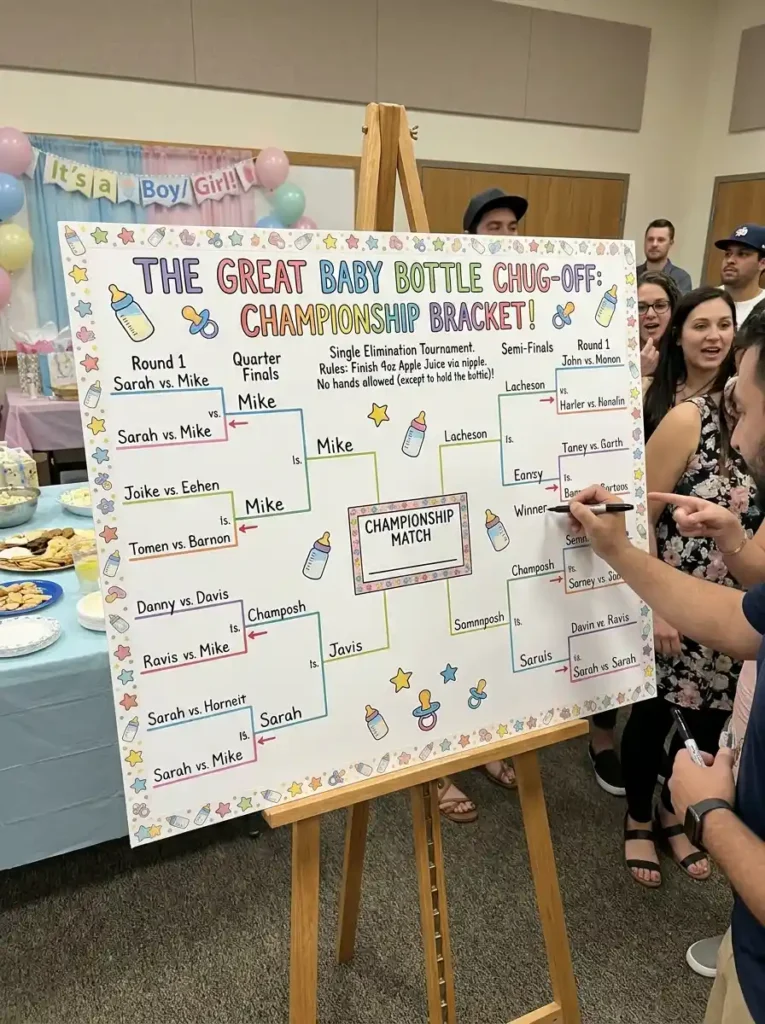
Tournament Format:
- Seed all entering guests in a standard bracket (online bracket generators are free)
- Announce each match-up with theatrical seriousness
- The champion of each match advances; the loser receives a consolation title
- The final is played in the center of the room with all remaining guests as audience
- Optional: a play-by-play commentator keeps the crowd engaged during each match
The Revelation: The physics of a baby bottle nipple — designed for a newborn’s sucking capacity — make finishing even a small bottle much harder than expected for most adults. The discovery of this fact during a competitive match creates the specific kind of surprised physical comedy that is universally funny.
What You Need:
- Baby bottles (one per two competing guests — rinsed between rounds)
- Apple juice
- Printed or written tournament bracket
- Optional: a “championship belt” made from ribbon and cardboard
Players: 8 to 20 guests
Duration: 30 to 40 minutes
Why It’s Perfect for Co-ed Groups: Bottle chugging requires no prior knowledge, no gender-specific experience, and no skill that advantages one group over another. The playing field is completely level.
5. Blind Taste: Baby Food Versus Real Food
Guests are blindfolded and presented with two small samples — one from a baby food jar and one made from real adult ingredients. They must correctly identify which is the baby food and which is the real food.
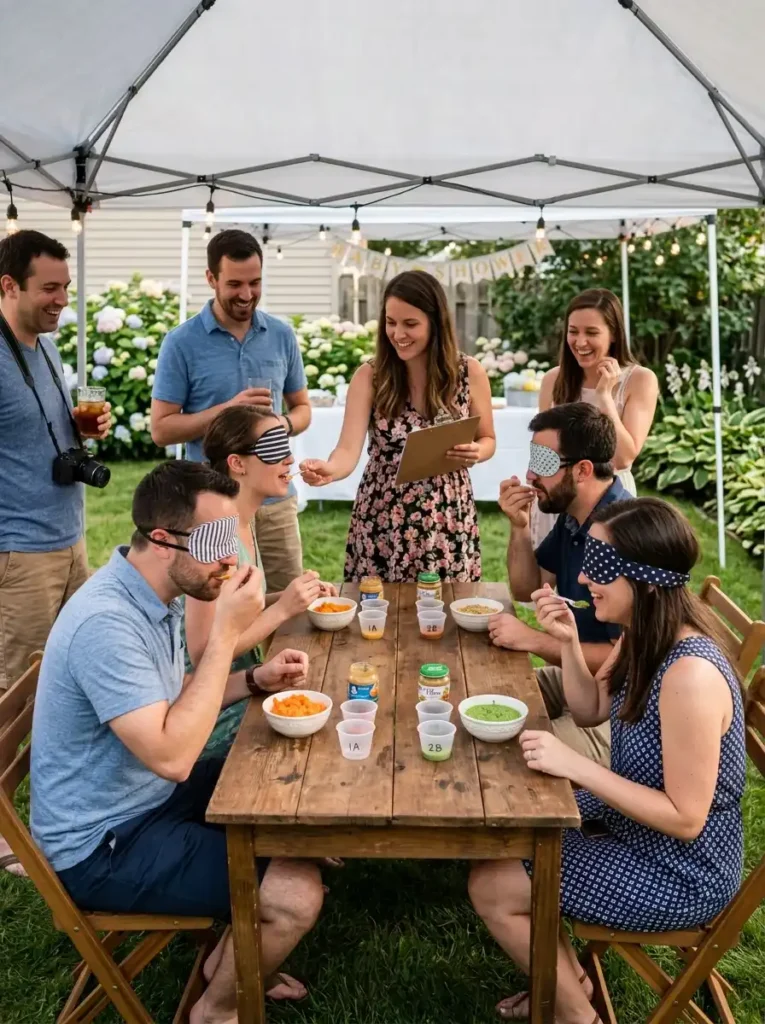
The Pairs That Create Maximum Confusion:
Pair 1:
- Baby sweet potato puree vs homemade blended sweet potato
- (These taste remarkably similar — first round confidence destroyer)
Pair 2:
- Baby pea puree vs blended adult peas
- (The baby version is typically sweeter — interesting)
Pair 3:
- Baby beef medley vs actual blended beef stew
- (The baby version typically wins this comparison, which disturbs people)
Pair 4:
- Baby prune puree vs blended adult prunes
- (Both are equally alarming)
Pair 5:
- Baby “apple and banana” dessert pouch vs homemade apple and banana blend
- (The baby pouch version is often preferred, which produces specific existential distress)
Scoring: One point per correct identification. The guest who correctly identifies the most pairs wins. The guest who consistently prefers the baby food version receives a special award.
Players: All guests, blindfolded individually or in small groups
Duration: 20 to 25 minutes
Why It Works for Co-ed Groups: Food assessment is completely gender-neutral and the results are equally surprising for every demographic. The “I actually preferred the baby food” revelation produces universal, non-gendered comedy.
KNOWLEDGE AND TRIVIA GAMES
6. Baby Trivia Championship (Teams of Mixed Gender)
A pub quiz-style trivia competition covering baby facts, parenting statistics, celebrity baby names, animal baby names, and deliberately obscure baby-related knowledge — organized in rounds, scored competitively, and hosted with the energy of an actual quiz night.

Round 1 — Baby Science:
- At what age does a baby first smile socially (not a reflex smile)? (6 to 8 weeks)
- How many bones does a newborn have compared to an adult? (Newborns: 300; Adults: 206)
- What percentage of a baby’s body weight is water at birth? (approximately 75%)
- How long does the average newborn sleep per day? (14 to 17 hours, though never consecutively)
- At what age do most babies say their first word? (Around 12 months)
Round 2 — Celebrity Baby Names:
- Name five real celebrity children named after inanimate objects or concepts
- Match the celebrity to the child’s name (North, Apple, Pilot Inspektor, Zuma, Buddy Bear)
- True or False: is “Hashtag” a real name given to a child? (True — several times)
Round 3 — Baby Animal Names:
- Baby platypus (puggle)
- Baby hedgehog (hoglet)
- Baby goat (kid)
- Baby kangaroo (joey)
- Baby porcupine (porcupette)
- Baby otter (pup or whelp)
- Baby flamingo (flaming-o — just kidding: chick or flaminglet)
Round 4 — Parents’ History (Personalized): Questions about the couple prepared in advance by the host — how they met, their first holiday, the father-to-be’s reaction when they found out, the mother-to-be’s strangest pregnancy craving.
Scoring: Standard pub quiz format — teams write answers, host reveals correct ones, teams exchange and mark each other’s papers.
What You Need:
- Prepared question cards or slides
- Answer sheets per team
- Pens
- Optional: a whiteboard for running scores
Players: Teams of 3 to 5 guests (aim for 3 to 6 teams)
Duration: 35 to 45 minutes
Why It’s Perfect for Co-ed Groups: A pub quiz format is immediately familiar and comfortable for mixed groups. The personalized “parents’ history” round ensures it never feels like generic trivia.
7. Price Is Right: Baby Edition
Guests individually guess the retail price of a series of baby products displayed on a screen or on printed cards. The guest whose total price guess is closest to the actual combined retail price wins.
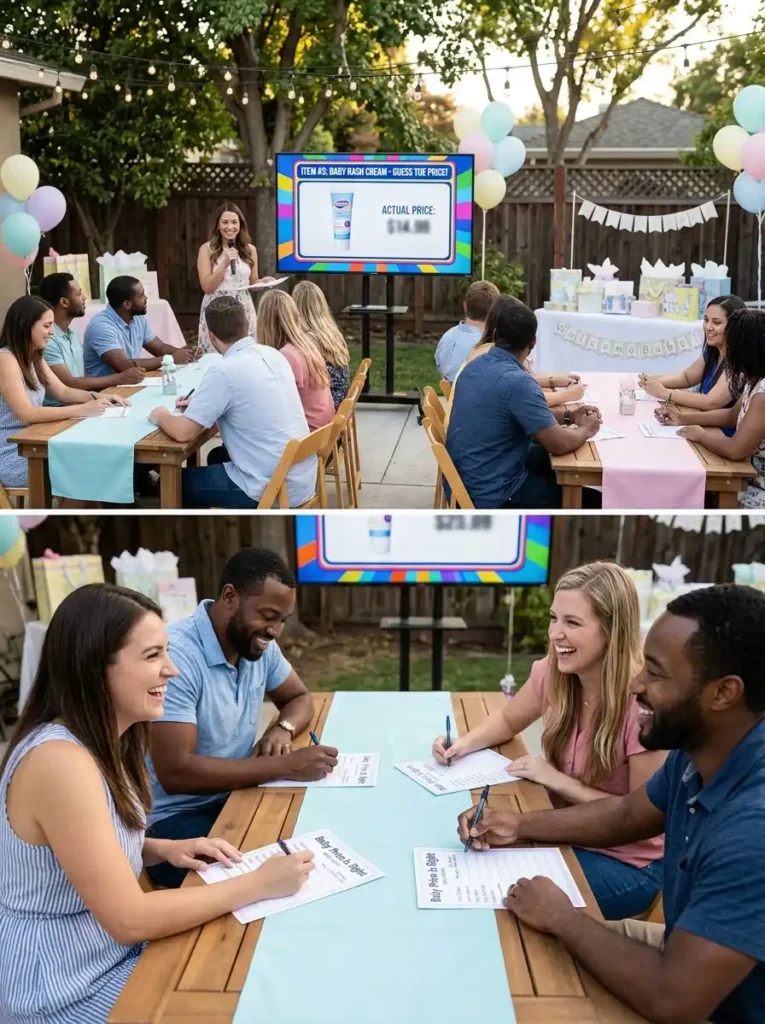
Products to Include (Chosen for Maximum Surprise):
- A designer baby stroller (the price will shock non-parents)
- A breast pump (price range is enormous — $30 to $500+)
- A single pair of designer baby shoes in a size that fits for approximately six weeks
- A video baby monitor with phone app connectivity
- A six-pack of newborn diapers (price per diaper calculation is revealing)
- A white noise machine designed specifically for babies
- A specific formula brand (one month’s supply)
- A baby sleep consultant’s single consultation fee
The Format: Reveal each product on a screen or hold up printed images. Guests write their price guess. After all products are revealed, guests calculate their total guess. Host reveals actual prices and total. Closest total wins.
Why Non-Parents Are Genuinely Shocked: The cumulative price of basic baby supplies regularly astounds guests who have not yet purchased them. The revelation that a pair of shoes that will fit for six weeks costs $85 produces a specific expression on men’s faces that is genuinely priceless.
Players: Any number (individual)
Duration: 20 to 25 minutes
8. He Said She Said: Parents Edition
The host has secretly asked both parents the same questions in advance. Guests must guess which answer belongs to which parent — and the parents reveal whether the guesses are correct in real time.
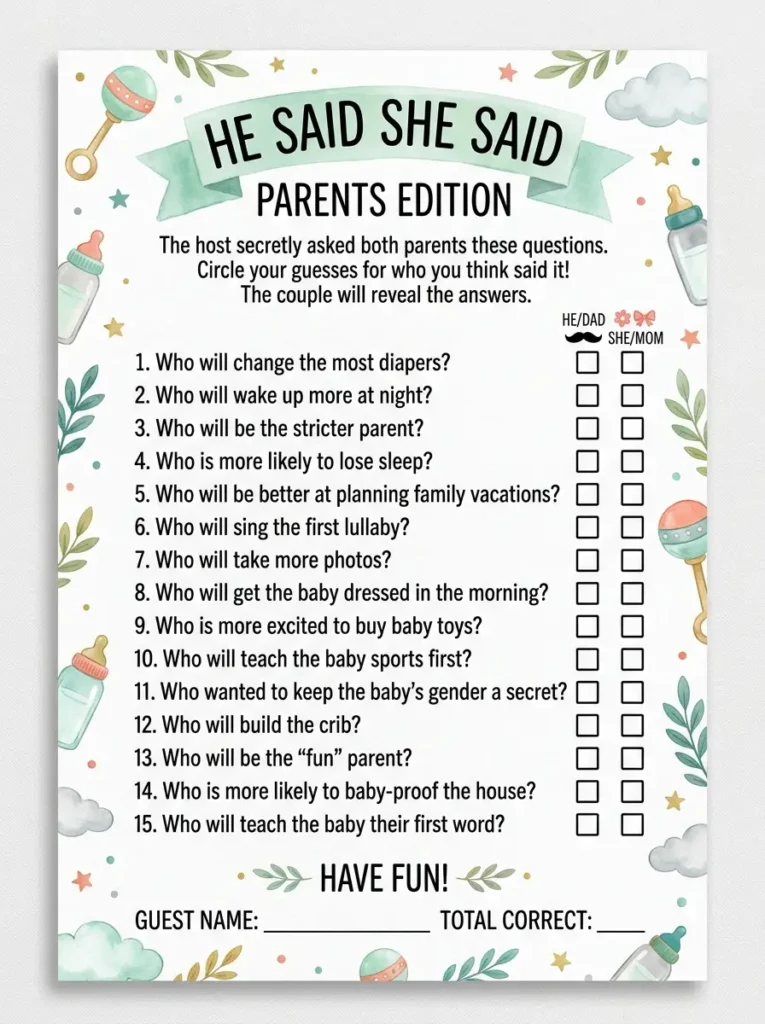
Questions to Ask Both Parents in Advance:
Parenting Philosophy:
- “Which parenting approach do you plan to take?” (strict, relaxed, balanced)
- “How many children do you want in total?”
- “Which parent will be stricter?”
- “Who will be the fun parent?”
Practical Predictions:
- “Who will be better at bath time?”
- “Who will crack first on the no-sugar rule?”
- “Who will be unable to say no when the baby cries?”
- “Who will be first to post an embarrassing baby photo on social media?”
Honest Admissions:
- “What parenting skill are you most worried about?”
- “What is the one thing your own parents did that you have promised yourself you will never do?”
- “What are you most looking forward to about being a parent?”
- “What are you most genuinely terrified about?”
The Live Reveal: Each question is read aloud. Guests vote for which parent gave which answer. Both parents then reveal simultaneously — thumbs up for “this was mine” or thumbs down. The gap between guest predictions and reality (and between each parent’s actual answers) produces genuinely revealing and genuinely funny moments.
Players: All guests
Duration: 25 to 30 minutes
Why It Works for Co-ed Groups: He Said She Said directly includes the father-to-be as a central participant rather than an audience member — and the honest admissions questions often produce the most unexpectedly moving moments of any co-ed shower.
9. Worst Parenting Advice in History
Guests are read genuine parenting advice from different historical eras and must guess approximately when the advice was given. The winner is the guest who correctly dates the most pieces of advice.
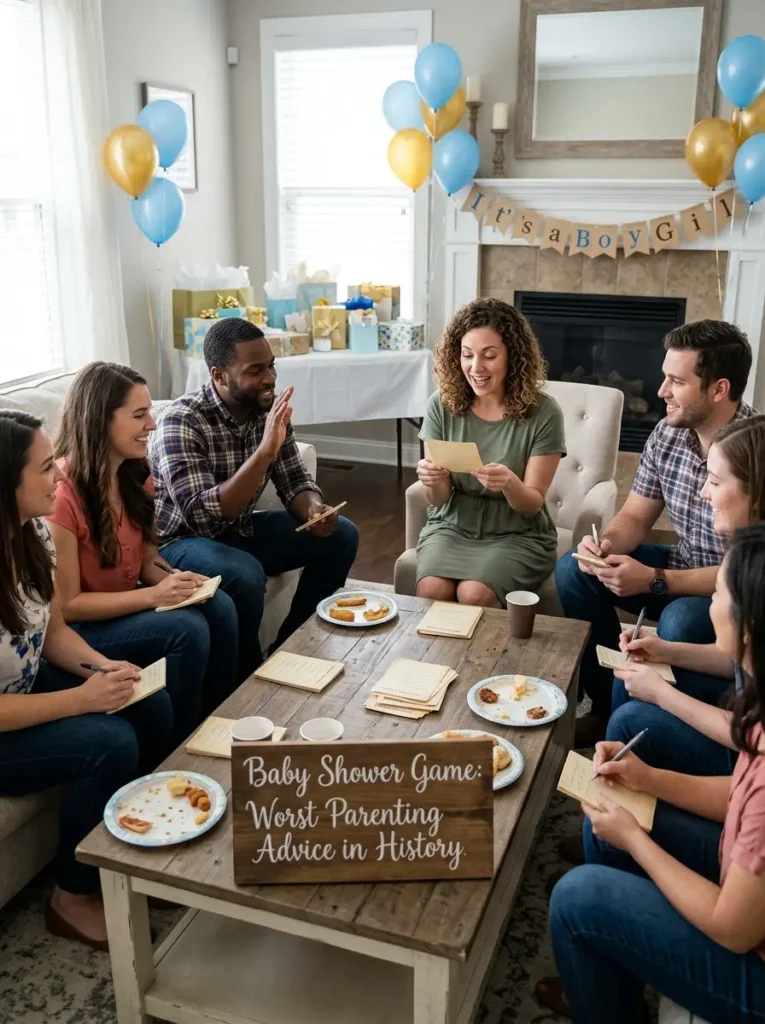
Historical Parenting Advice Examples:
1910s: “Do not kiss your child on the lips. The mouth is a dangerous source of disease transmission.” — John B. Watson, behavioral psychologist, 1913
1920s: “A daily sunbath of 20 to 30 minutes is recommended for all infants over one week old, including full exposure on sunny days.”
1950s: “Babies should be fed on a strict four-hour schedule. Do not pick up a crying baby between feeds, as this will spoil them.”
1960s: “A teaspoon of brandy in warm milk is an effective remedy for infant colic and will help the baby sleep.”
1970s: “Babies should sleep on their stomachs to prevent choking if they spit up.” (The opposite is now known to be safer — back sleeping reduces SIDS risk.)
1980s: “Fruit juice is a healthy alternative to water for infants and can be given from birth.”
Why This Works for Co-ed Groups: Historical medical and parenting advice is universally shocking and universally funny regardless of gender or parenting experience. The progression from “was this really advice?” to “people genuinely believed this?” creates a consistent rhythm of comic disbelief.
Players: Any number
Duration: 20 to 25 minutes
10. Would You Rather: Parenting Edition
A rapid-fire competitive game where teams or individuals must make and defend increasingly difficult parenting “would you rather” choices. Points are awarded for the most creative defense of a genuinely defensible position.
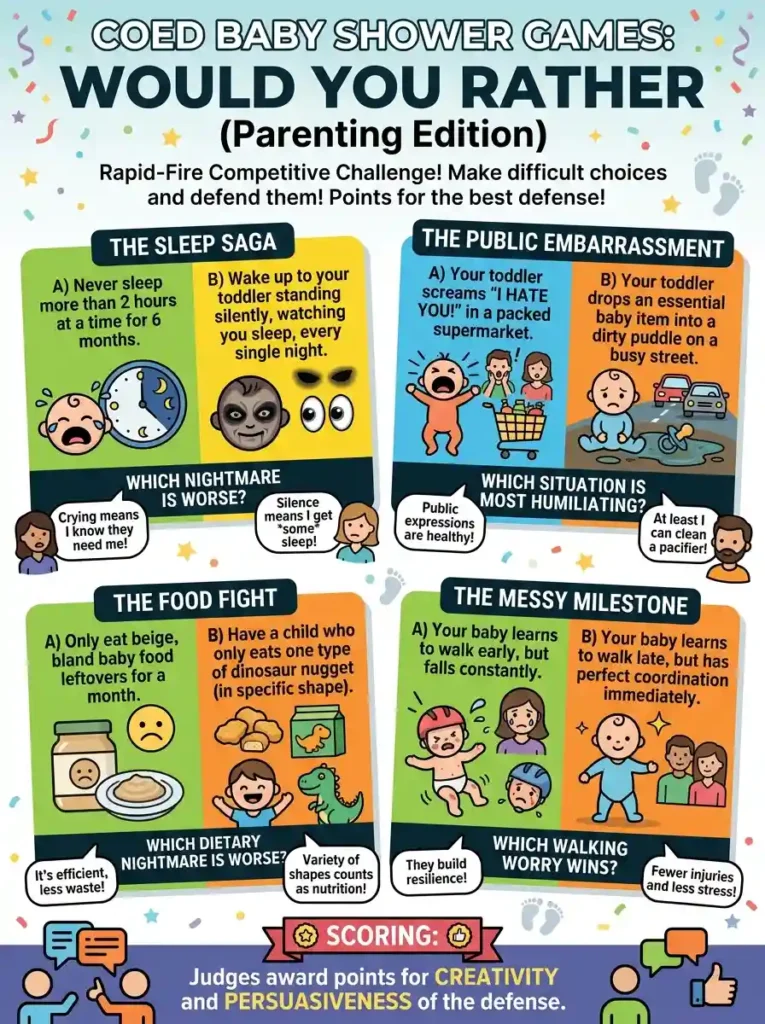
Would You Rather Scenarios:
Easy Round:
- Would you rather: Baby only sleeps if held, or baby only sleeps if moving in the car?
- Would you rather: Baby screams in restaurants, or baby is silent but completely refuses all food?
Medium Round:
- Would you rather: Your child becomes a professional mime, or a professional clown?
- Would you rather: Your child goes through a phase of repeating everything you say, or a phase of asking “why?” after every single statement?
Hard Round:
- Would you rather: Know every thought your child has from age 13 to 18, or have your child know every thought you had at that age?
- Would you rather: Your child’s first word is an embarrassing word they heard at home, or your child refuses to speak until age three?
Parent-Specific Round (Directed at the Parents-to-Be):
- Would you rather: Three months of no sleep but a perfectly healthy baby, or six months of good sleep but constant mild anxiety?
- Would you rather: Your child inherits your best quality, or your partner’s best quality?
Competitive Format: After each scenario, teams vote on an answer and must provide a one-sentence defense. The most convincing defense (as judged by the parents-to-be) scores a point. This rewards wit and persuasion rather than knowledge.
Players: Teams of 2 to 4 guests or individual play
Duration: 20 to 25 minutes
TEAM GAMES
11. Baby Product Infomercial (Mixed Teams)
Teams of mixed gender are given an imaginary baby product and must create and perform a thirty-second infomercial, complete with product features, a demonstration, and a price reveal. Judged by the parents-to-be.
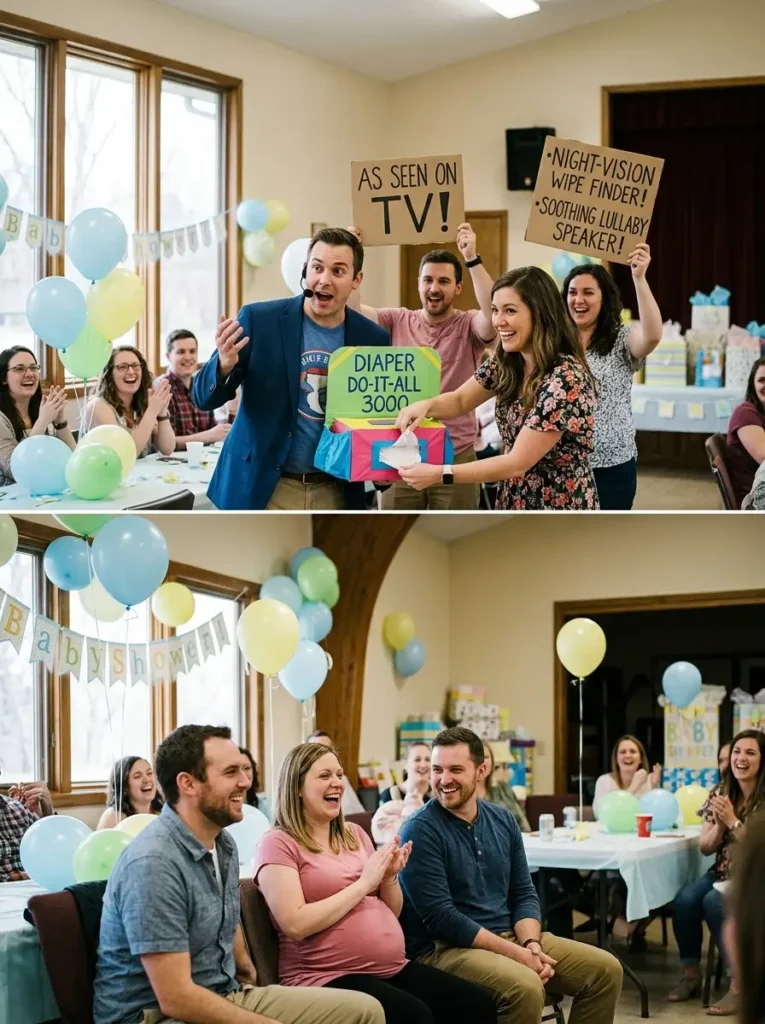
Imaginary Products:
- The CryTranslator Pro (tells parents exactly what the baby wants)
- The SleepGuarantee 3000 (claims to make any baby sleep through the night)
- The Unsolicited Advice Deflector (a shield against well-meaning relatives)
- The Patience Refiller (restores parental patience instantly at 4am)
- The Developmental Milestone Predictor (tells parents exactly when the baby will walk, talk, and stop throwing food)
- The In-Law Comment Filter (automatically rephrases all unsolicited parenting criticism into compliments)
Requirements for Each Infomercial:
- A product name and tagline
- Three specific features (with demonstrations)
- One dramatic before-and-after moment
- A price that the audience will find either absurdly expensive or insultingly cheap
- A closing call to action
Why Mixed-Gender Teams Make This Better: The combination of perspectives — some with parenting experience, some without; a mix of communication styles and humor registers — consistently produces richer, funnier, more creative infomercials than single-gender teams. The competition between teams with different approaches is more interesting.
Players: Teams of 3 to 4 guests (3 to 5 teams)
Duration: 35 to 45 minutes
What You Need: Product assignment cards, five minutes preparation time, optional prop box
12. Baby Name Debate
Teams are given a list of five baby names and must rank them from “most likely to succeed” to “most likely to be bullied at school” — then defend their ranking to the room in a structured debate format, with the other team arguing the opposite position.

Name Lists to Use (Each Team Gets a Different List):
List 1: Jasper, Persephone, Dave, Moonbeam, Charlotte
List 2: Atticus, Gertrude, Max, Hashtag, Sophia
List 3: Wolverine, Emma, Crispin, Blue, James
List 4: Apple, Benjamin, Wren, Tarquin, Grace
Debate Rules:
- Each team presents their ranking with one sentence of justification per name
- The opposing team challenges any two placements they disagree with
- The parents-to-be cast the deciding vote on contested rankings
- One point per ranking that the parents-to-be agree with
Why This Works for Co-ed Groups: Baby name opinions are held by every person in every room regardless of gender, age, or parenting status. The structured debate format gives permission to express those opinions — and the parents-to-be’s visible reactions to how their guests rank various names is consistently entertaining.
Players: Two teams of 3 to 5 guests
Duration: 25 to 30 minutes
13. Lullaby Remix Challenge
Teams are given a classic lullaby and ten minutes to rewrite it as a completely different music genre — country, hip-hop, heavy metal, opera, 80s power ballad — and then perform it live.

Lullabies to Assign:
- Twinkle Twinkle Little Star (classic starting point)
- Rock-a-Bye Baby
- Hush Little Baby
- You Are My Sunshine
- Baa Baa Black Sheep
Genres to Assign:
- Country and western (very accessible — most people can do a passable country accent)
- Hip-hop (produces consistently excellent results)
- Heavy metal (the contrast with the gentle lullaby content is immediately funny)
- 80s power ballad (hair flicking is mandatory)
- Opera (commitment is everything)
- Reggae (the rhythm transformation of Twinkle Twinkle is magnificent)
Scoring Criteria:
- Accuracy to the genre (does it actually sound like that genre?)
- Creativity of the lyrics (did they just change the speed or did they genuinely rewrite?)
- Performance commitment (are they fully in it?)
- Audience reaction (measured by noise level and visible enjoyment)
Why Mixed Gender Teams Make This Better: Music performance games benefit from a range of voices, comedic approaches, and willingness to commit to the absurd. Mixed teams consistently produce more varied and more interesting performances than same-gender groups.
Players: Teams of 3 to 5 guests
Duration: 30 to 40 minutes
14. Co-ed Diaper Relay Race
A relay race where teammates must pass a baby doll down the line — each team member completing one step of a diaper change before passing the doll to the next person. Teams of mixed gender and mixed experience compete simultaneously.
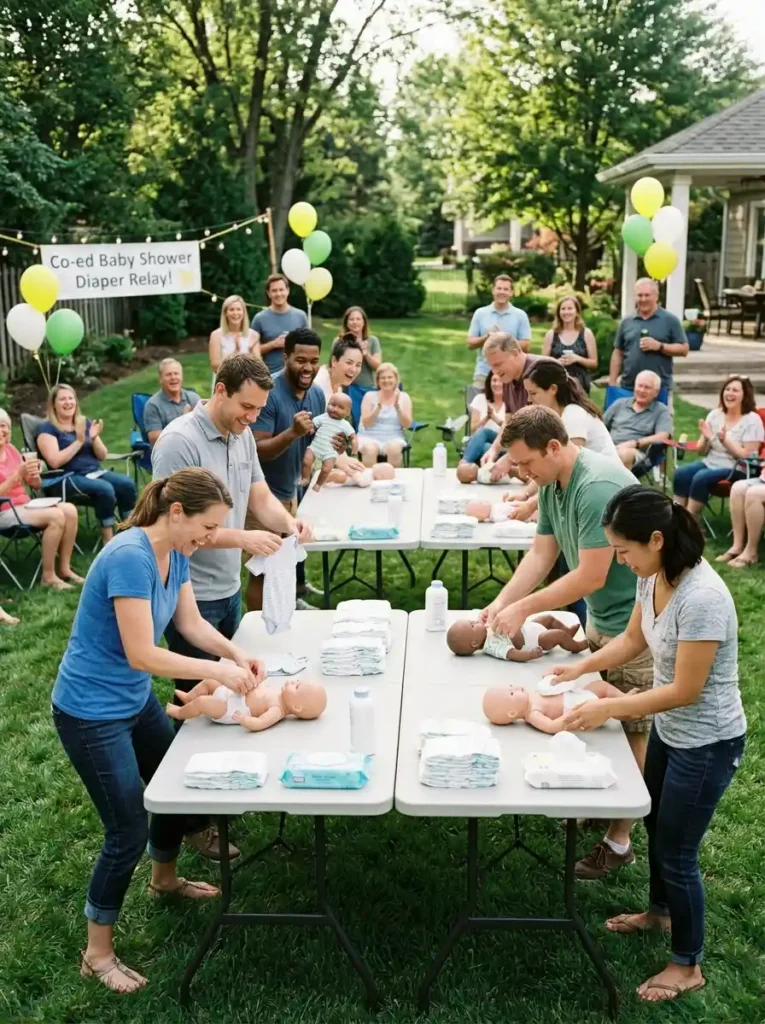
The Relay Steps:
- Team member 1: Lay the doll on the changing mat and unfold the new diaper
- Team member 2: Remove the old diaper and wipe the doll
- Team member 3: Position the new diaper correctly under the doll
- Team member 4: Secure the two bottom tabs
- Team member 5: Secure the two top tabs (creating a correctly fitting diaper)
- Team member 6: Lift the doll and hold it correctly — the judge checks the diaper fit
Penalty Rules:
- Crooked tabs: 5 second penalty
- Diaper falling off when the doll is lifted: restart the entire diaper
- Dropping the doll: 10 second penalty
- Anyone on the team touching the doll outside their step: 5 second penalty
Players: Teams of 5 to 7 guests
Duration: 20 to 25 minutes
15. Parenting Scenario Roleplay
Teams are given a parenting scenario card and must roleplay the scenario as a couple — both parents, dealing with the situation — for sixty seconds. The audience scores the performance on realism, creativity, and most convincingly calm parent under pressure.

Scenario Cards:
Scenario 1: “Your baby has just said its first word in the middle of Thanksgiving dinner. The word is not appropriate for the table. Roleplay the next sixty seconds.”
Scenario 2: “You are in a packed elevator. The baby produces a diaper situation of catastrophic proportions. The elevator is between floors. Roleplay the next sixty seconds.”
Scenario 3: “Your in-laws have just arrived unannounced. The house is in a state. The baby has not slept in two days. Neither have you. Roleplay welcoming them.”
Scenario 4: “Your toddler has just very loudly and very clearly repeated something you said at home, in the middle of a quiet doctor’s waiting room, to a room of forty strangers.”
Scenario 5: “The baby has just crawled for the first time. You are alone in the house. You need to document this milestone. Your phone battery is at 1%.”
Why This Works for Co-ed Groups: Roleplay scenarios that require a “couple” dynamic naturally create mixed-gender pairs and produce genuinely funny performances that acknowledge the shared experience of parenthood as a team effort.
Players: Pairs of guests (can be any combination of genders)
Duration: 25 to 30 minutes
GROUP PARTICIPATION GAMES
16. Baby Bingo (Co-ed Edition)
Not the traditional baby bingo. This version uses bingo cards filled with specific predictions about the co-ed shower itself — guest behavior, gift types, and party moments. Cards are distributed at the start; guests mark squares as events occur naturally throughout the shower.
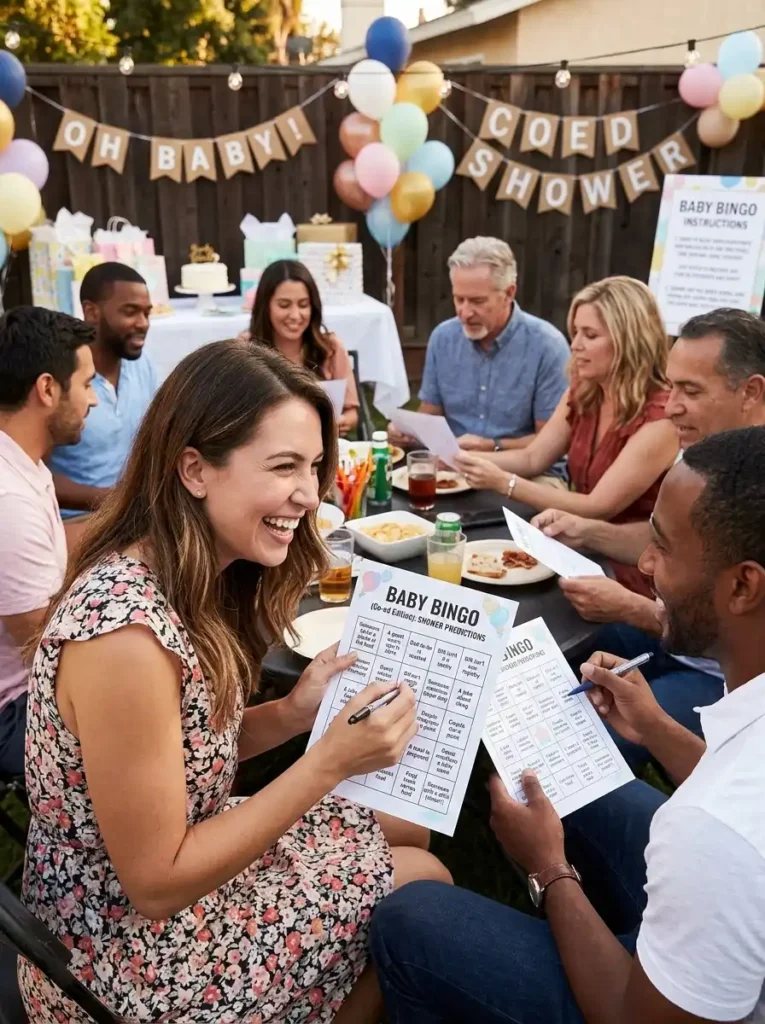
Squares on the Co-ed Edition Bingo Card:
- “A man holds the baby doll first”
- “Someone says they already knew the gender”
- “A guest arrives more than 15 minutes late”
- “Someone uses the word ‘adorable’ in the first five minutes”
- “The father-to-be looks genuinely terrified during a game”
- “A guest gives unsolicited parenting advice”
- “Someone mentions how fast babies grow”
- “A gift is opened and nobody knows what it is”
- “The mother-to-be cries”
- “The father-to-be pretends not to cry”
- “A guest takes a selfie with the mother-to-be without asking”
- “Someone makes a joke that lands in total silence”
- “Two guests give the same gift”
- “Someone asks when the next baby will be”
- “A guest falls asleep mid-shower” (rare but legendary)
How to Win: First guest to complete a full line (horizontal, vertical, or diagonal) and shout “Baby Bingo!” wins. The twist: the game runs for the entire shower, so guests are observing and marking their cards throughout all other activities.
Players: All guests
Duration: Entire shower
17. Guess the Nursery Rhyme: Charades Edition
One guest acts out a nursery rhyme without speaking. The rest of the room (or their team) must correctly identify which rhyme is being performed. Co-ed groups are given deliberately obscure nursery rhymes that require creative interpretation.

Nursery Rhymes to Include:
- Humpty Dumpty (seems easy; the wall is difficult to convey)
- Jack and Jill (the tumbling is universally funny)
- Little Miss Muffet (the spider moment is everything)
- Old MacDonald Had a Farm (the animal sounds are the trap — no speaking)
- Mary Had a Little Lamb (lamb movements in a co-ed setting)
- The Grand Old Duke of York (marching — unexpectedly complex)
- Baa Baa Black Sheep (another no-speaking animal challenge)
- Incy Wincy Spider (the waterspout is interpretively demanding)
Why Co-ed Groups Make This Funnier: Men performing nursery rhyme charades — particularly the spider and the lamb — with complete physical commitment produce the specific kind of comedy that becomes a reference point for years. “Remember when Josh did his spider impression?” is a real sentence that will be said at every gathering this group has for the next decade.
Players: Individual performance (6 to 20 guests)
Duration: 20 to 30 minutes
18. Don’t Say Baby: Co-ed Competition
The classic “don’t say baby” game restructured as a competitive points tournament rather than a passive pin-stealing exercise. Every guest starts with ten tokens. Every time a guest says “baby” (or any of three additional forbidden words chosen by the parents-to-be), any other guest who catches them takes one token. The guest with the most tokens at the end wins.
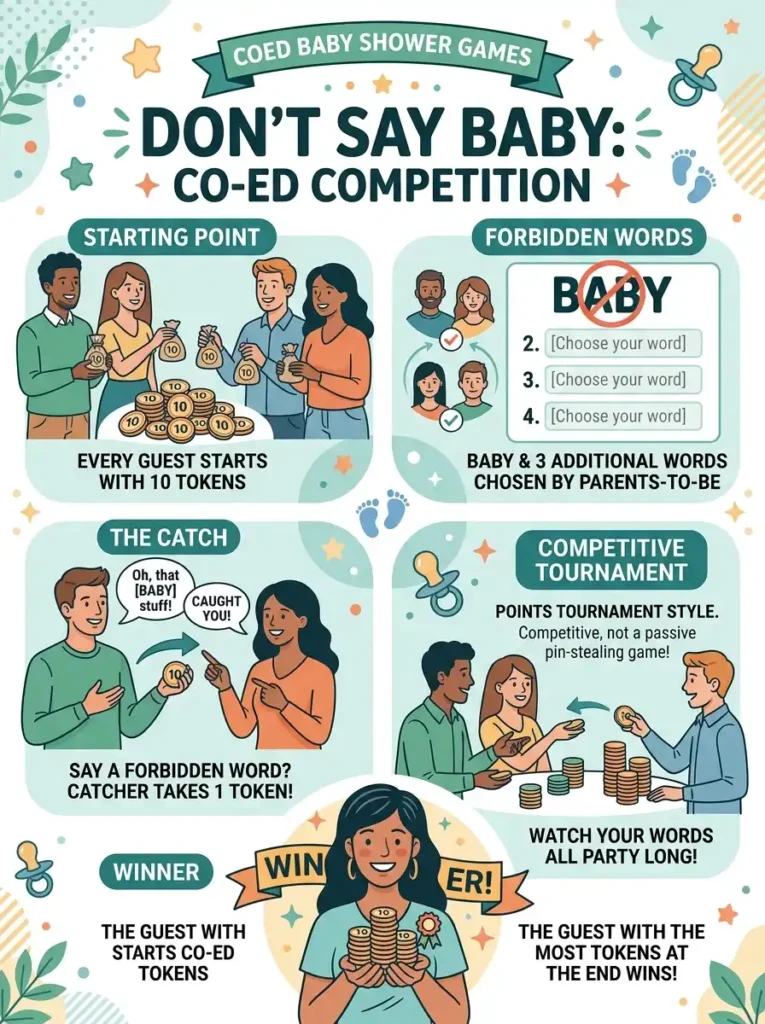
The Three Additional Forbidden Words (Co-ed Edition): The parents-to-be choose three words specifically likely to catch their specific guests off guard. For a co-ed shower, effective choices often include:
- The father-to-be’s most commonly used phrase (“basically,” “to be fair,” or “honestly”)
- A word specific to the group’s profession or shared culture
- A word the mother-to-be knows her partner says constantly without realizing
Why This Version Works Better for Co-ed Groups: The personalized forbidden words — chosen specifically to target the likely speech patterns of the actual guests — make this a game about knowing these specific people in this specific room rather than a generic baby shower game.
Players: All guests
Duration: Entire shower
What You Need: 10 tokens per guest (coins, clips, or beads work perfectly)
19. Baby Photo Wall: Name That Guest
Every guest submits a baby photograph before the shower (requested on the invitation). Photos are printed, numbered, and displayed on a wall or board. Guests have the duration of the cocktail hour to match each baby photo to the adult guest they believe it depicts.

The Co-ed Twist: Include photos of both men and women — and deliberately include photos that challenge gender assumptions. The guests who are most confidently wrong about specific identifications are consistently the funniest reveals.
Bonus Round: Include three or four photographs of celebrities as baby photos. Award a bonus point for each celebrity correctly identified.
What You Need:
- Baby photos collected in advance from all guests
- Printed and numbered display on a board or wall
- Answer sheets and pens
- Optional: celebrity baby photos as decoys
Players: All guests
Duration: 20 to 30 minutes for the matching; reveal at the end of the shower
20. The Parents’ Predictions Vs Reality Check
The parents-to-be have both completed a “predictions” questionnaire in advance — their expectations, plans, and confident assertions about how they will approach parenthood. Guests hear each prediction read aloud and vote on whether it will survive contact with an actual baby.
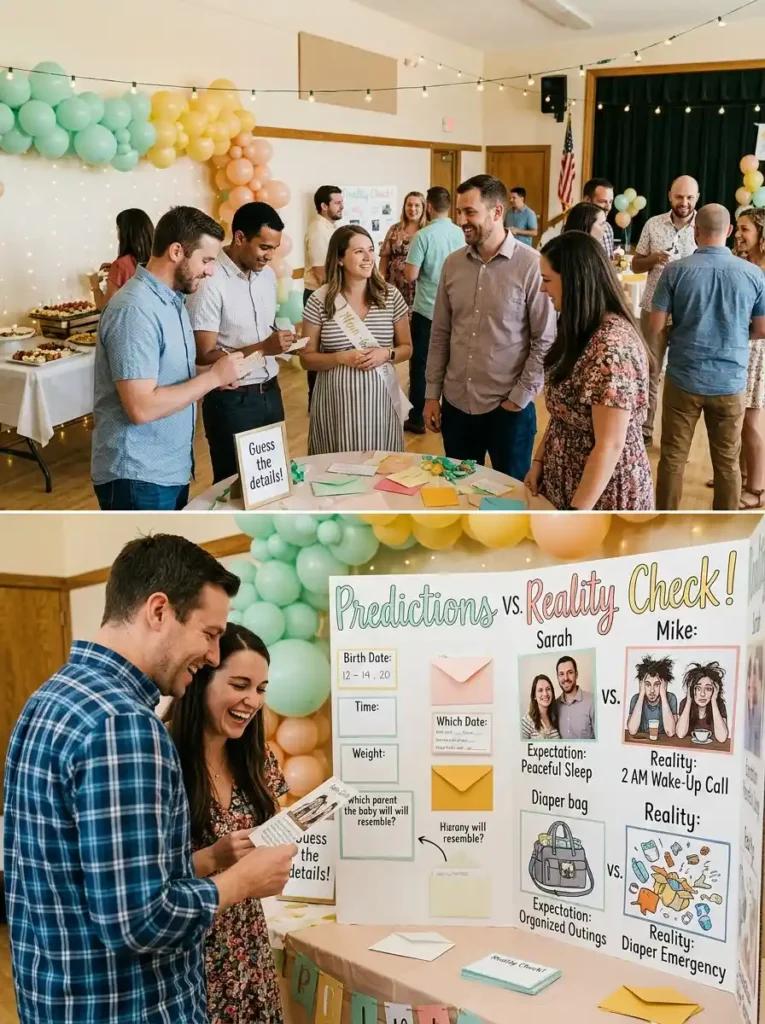
Prediction Categories:
Sleep and Schedule Predictions:
- “We will maintain our existing social schedule for the first three months”
- “We will not let the baby sleep in our bed”
- “We will stick to the recommended sleep schedule from birth”
Parenting Philosophy Predictions:
- “We will not use screens as entertainment before age two”
- “We will keep all toys in the toy room, not spread through the house”
- “We will read to the baby every night without exception”
Couple Predictions:
- “We will keep at least one date night per month”
- “We will agree on all major parenting decisions before implementing them”
The Voting System: Guests vote “Will Survive” or “Will Not Survive Contact With Reality” for each prediction. Experienced parents in the room provide brief commentary on each one. The parents-to-be’s visible reactions to the voting outcomes — and to the experienced parents’ commentary — are the entertainment.
Players: All guests
Duration: 20 to 25 minutes
21. Story Stones: Dad Edition
Sets of illustrated story stones (or cards with simple images) are placed in the center of the group. The father-to-be draws three stones at random and must tell a sixty-second story — completely improvised — that incorporates all three images, ends with a moral lesson for the baby, and includes at least one parenting scenario.
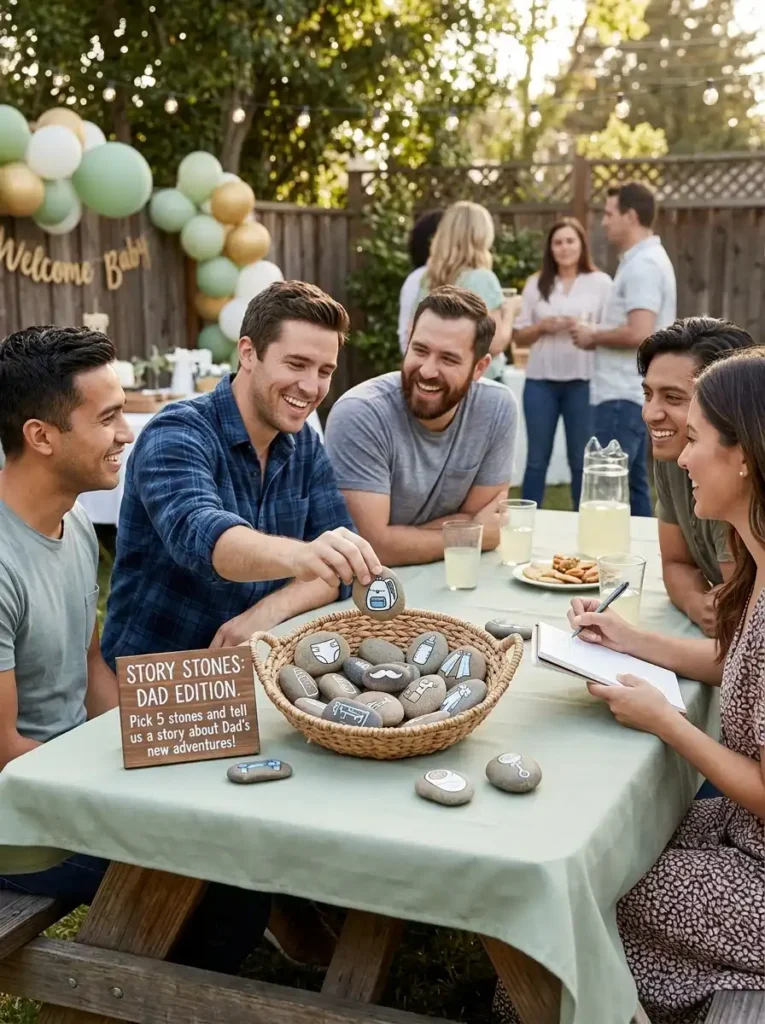
Stone Images to Include:
- A dragon
- A castle
- A very tired person
- A bottle
- A mountain
- A unicorn
- A shopping cart
- A phone at 1% battery
- A pile of laundry
- A sleeping cat (the cruelest stone — the one thing the parents will not have)
- A clock showing 3am
- A superhero cape
- A poop emoji (this is a baby shower)
- A heart
Why “Dad Edition” Works for Co-ed Groups: Centering the father-to-be as the protagonist of the story-telling game creates immediate buy-in from male guests who identify with his position and from female guests who enjoy watching him navigate the creative constraint. The parenting-themed images ensure every story connects to the occasion.
Players: The father-to-be as primary performer; guests can take turns
Duration: 15 to 20 minutes
22. The Exhausted Parent Challenge
One guest is designated “the exhausted parent” and must complete a series of mundane tasks while the rest of the group acts as distractions — calling their name, asking questions, making noises, and generally replicating the experience of trying to accomplish anything simple while being needed by small children simultaneously.
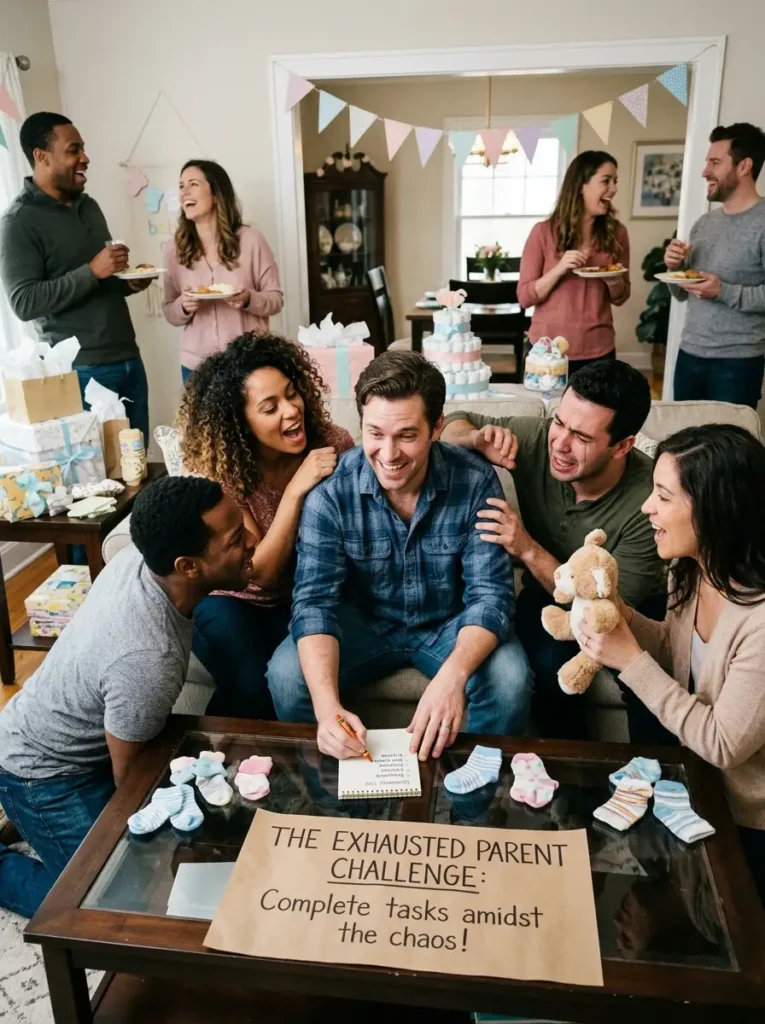
The Tasks (In Order of Increasing Difficulty):
Task 1: Read a four-sentence paragraph aloud without losing their place (guests interrupt with “but why?” after every sentence)
Task 2: Complete a simple five-piece puzzle while three guests simultaneously ask them unrelated questions they must answer
Task 3: Write a complete shopping list of ten items while someone reads a completely different list aloud at the same volume
Task 4: Fold three items of clothing while responding to a “phone call” (a guest reading a script of mundane but apparently urgent questions)
Task 5 — Final Boss: Hold a baby doll in one arm, answer three trivia questions, and simultaneously pretend to stir a pot on an imaginary stove — all at the same time
Scoring: Tasks are timed and judged for accuracy. Penalty points for losing their place, making errors, or breaking character. The guest who maintains composure and accuracy for the longest is crowned “Most Ready to Be a Parent.”
Why This Works for Every Guest: The Exhausted Parent Challenge requires no specific knowledge and no physical ability — only the universal human capacity to try to think clearly when multiple people need things from you simultaneously. This experience resonates with every guest regardless of gender or parenting status.
Players: Individual guests rotating through
Duration: 25 to 30 minutes
What You Need: A paragraph of text, a simple puzzle, a list, a “phone call” script, a baby doll, an imaginary pot
CO-ED BABY SHOWER GAME PLANNING GUIDE
Recommended Game Lineup by Shower Type
For a Large Co-ed Shower (30+ Guests):
- Baby Bingo Co-ed Edition (running the whole time — everyone participates)
- Baby Trivia Championship (teams work for large groups)
- Pregnant Obstacle Course (relay format — large groups work as team cheering sections)
- Don’t Say Baby Co-ed Competition (runs all shower)
For a Medium Co-ed Shower (15 to 30 Guests):
- He Said She Said (personal, everyone votes)
- Diaper Changing Olympics (individual heats with audience)
- Baby Name Debate (teams)
For an Intimate Co-ed Shower (Under 15 Guests):
- Story Stones Dad Edition (intimate, personal)
- Would You Rather Parenting Edition (discussion-based)
- The Exhausted Parent Challenge (everyone participates or watches)
- Parents’ Predictions Vs Reality Check (group discussion)
Prize Ideas for Co-ed Showers
The best co-ed shower prizes appeal to all genders:
- A quality bottle of wine, spirits, or craft beer
- An artisan candle or home fragrance set
- A gift card to a local restaurant
- Quality coffee or tea selection
- A beautiful plant or succulent
- A streaming service gift card
- A book (non-baby-related — a novel or a cookbook)
- A local experience voucher
Avoid: Prizes that feel specifically gendered or specifically baby-related — prizes at a co-ed shower should reward the winner regardless of who that person is.
COED BABY SHOWER GAMES FAQs
What makes a baby shower game work for both men and women?
The best co-ed games share three characteristics: they start from an equal knowledge position (nobody has a built-in advantage), they involve physical or creative elements that transcend gender-specific experience, and they are framed competitively enough to generate genuine engagement from guests who might otherwise hold back. Games that require specifically feminine experience or knowledge, or that assume guests have all been pregnant or are all planning to become mothers, do not work in a co-ed setting.
How do you get reluctant male guests to participate?
Structure and stakes. Men who politely decline passive activities become enthusiastic participants in bracket tournaments, relay races, and competitive team games. The key is framing the activity as a genuine competition rather than a participation exercise. A bracket tournament with a championship round and a prize creates investment. A pub quiz format creates instant comfort. A physical relay race creates immediate team bonding. The word “competition” does more work at a co-ed shower than any other single word.
How many games should a co-ed baby shower have?
Two to three structured games is ideal, supplemented by one ongoing game (like Don’t Say Baby or Baby Bingo) that runs throughout the shower without requiring everyone to stop and focus simultaneously. More than three structured games risks making the shower feel like a game show; fewer than two makes it feel unstructured. The ongoing game creates a constant low-level thread of engagement between the structured activities.
Should the father-to-be participate in games?
Absolutely, and ideally as a central participant rather than a judge or spectator. The co-ed shower exists to celebrate both parents — the father-to-be’s full participation in the games makes him a genuine part of the celebration rather than an addition to the traditional format. Games like He Said She Said, Story Stones Dad Edition, and the Parents’ Predictions vs Reality Check explicitly center the father-to-be and tend to produce the most personally meaningful moments of the entire shower.
What is the best co-ed baby shower game for breaking the ice?
The Baby Photo Wall (Name That Guest) is consistently the best ice-breaker for co-ed showers because it gives guests a reason to talk to everyone in the room while looking at the display, requires no performance in front of the group, and produces the kind of “wait, is THAT what you looked like?” conversations that create immediate connection. Price Is Right Baby Edition is the best structured ice-breaker game because the shared shock of baby product prices creates immediate collective experience across all guest demographics.
Can you mix co-ed games with some traditional baby shower activities?
Yes — and often the best co-ed showers do exactly this. The gift opening, the cake cutting, the toast, and the personal moments of celebration work beautifully in a co-ed setting. The games simply need to be chosen with the full guest list in mind. You can absolutely include a heartfelt advice card activity alongside a competitive diaper relay race — the contrast actually serves both elements better.
FINAL THOUGHTS
The best co-ed baby shower is one where nobody at the end of the night can remember which activities were “baby shower games” and which were just people having a genuinely good time together.
That is the standard. Not “it was fun for a baby shower.” Not “the men seemed okay with it.” The standard is: everyone in that room had a great night, everyone laughed until their face hurt, and everyone left feeling genuinely connected to the two people at the center of it — the parents who are about to begin one of the greatest adventures of their lives.
Use these 22 co-ed baby shower games to build a celebration that deserves exactly that kind of evening. Mix physical games with knowledge games. Include both parents as central figures. Create teams that mix your guest list rather than segregate it. Give everyone equal opportunity to embarrass themselves gloriously in a room full of people who love them.
That is what a co-ed baby shower is for.
That is what these games deliver.
Loved these co-ed baby shower game ideas? Save this article and share it with your shower host — and start planning the most genuinely fun mixed-group baby shower anyone in your circle has ever attended.
You Might Also Love:
- Baby Shower Themes for Every Style
- Trending Baby Shower Ideas
- Bridal Shower Games
- Non-Traditional Baby Shower Games
- 21 Hilarious Baby Shower Games
- Coffee Bridal Shower Theme
- Bridal Shower Menu Ideas
- Bridesmaid Proposal Gift Ideas
- Wedding Favour Ideas
- Wedding Guest Book Ideas
- Small Wedding Ideas
- Non-Traditional Wedding Ideas